Harald Fairhair: the king who swore not to cut his hair until he united Norway
According to the sagas, Harald swore to let his hair grow until he ruled all of Norway, which he achieved at Hafrsfjord. Historians view the story with caution.
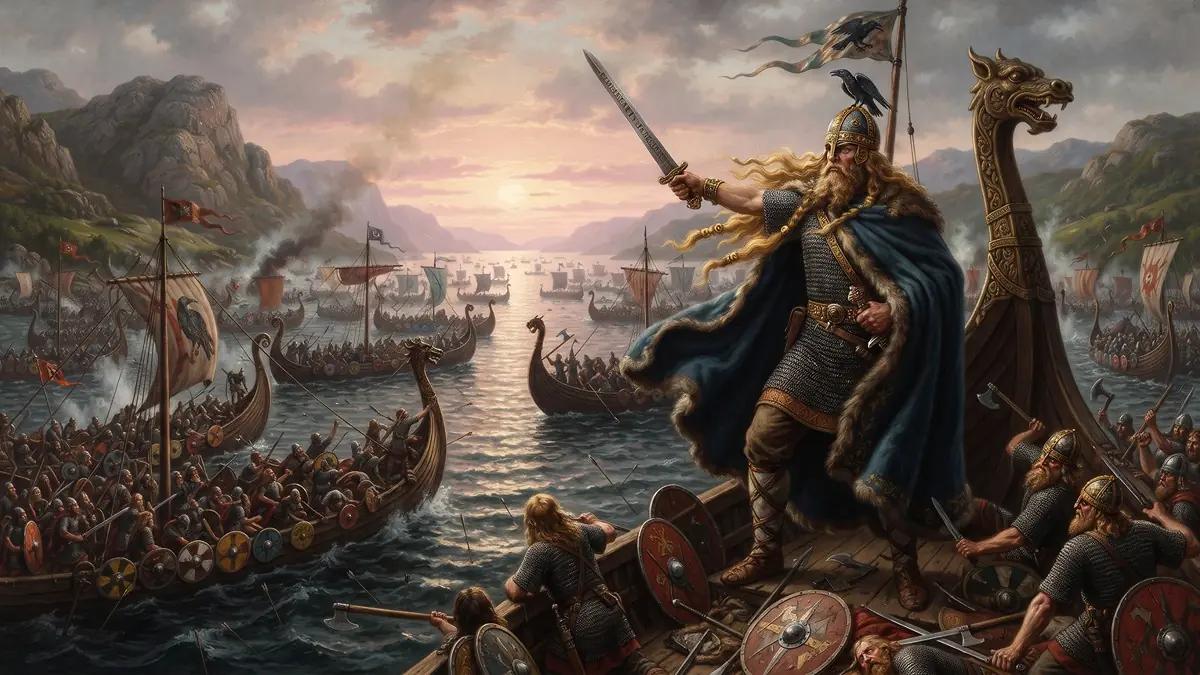
In several medieval accounts, Norway is born as a single kingdom through the work of one man: Harald Fairhair, in Old Norse Haraldr hárfagri. These accounts were written by Icelanders in the 13th century, long after the events, and tell a story that historians treat with caution.
The young king’s oath
According to Snorri Sturluson’s Heimskringla, Harald was the son of a petty king from the Vestfold region, in southern Norway, and inherited the throne while still young. The saga tells that he asked for the hand of Gyda, daughter of a king of Hordaland. She is said to have refused, saying she would only accept a man who was king of all Norway, and not just a piece of it.
Harald, the saga says, then made an oath: he would neither cut nor comb his hair until he was king of all Norway. For that reason the people called him Harald Shockhead, or Lúfa, “the shaggy”.
The battle at Hafrsfjord
In the following years, the saga says, Harald subdued kings and regional chieftains, one after another. The last great resistance would have been the naval battle of Hafrsfjord, near present-day Stavanger, where he faced a coalition of adversaries.
Tradition places it around the year 872. Modern scholars find this date uncertain, and many prefer to place the event later, near the year 900. There is no written account of the battle from the time.
After the victory, Snorri tells, Harald cut his hair, after ten years. The adviser who had backed him, Rögnvald, combed it, and the king came to be called Fairhair.
What the story does not settle
The texts that tell this were written more than three hundred years after the events. The poems of the skalds, preserved inside the sagas, are considered the oldest sources, but they do not confirm every detail. The oath scene is, in the view of many historians, a literary account and not a record.
The real reach of Harald’s power is also debated. The sagas say that many nobles fled his rule to Iceland and to the islands north of Scotland, but Norway remained divided by regional disputes after him. The unification of the country would have been a longer process than the saga presents.
Swords in rock
At Hafrsfjord there is today a monument from 1983, by the sculptor Fritz Røed, called Sverd i fjell, “Swords in Rock”. They are three bronze swords, about ten metres tall, driven into the stone at the edge of the fjord. The largest, according to the monument’s official explanation, represents Harald, and the two smaller ones the defeated kings.
To help Rögnvald with the comb, play Rögnvald’s comb.
Sources.
- Snorri Sturluson, *Heimskringla*, Saga of Harald Fairhair (c. 1230)
- *Fagrskinna*, compilation of sagas of Norwegian kings (13th century)
- Monument *Sverd i fjell* (Swords in Rock), Hafrsfjord, Stavanger, unveiled in 1983