Grettir and the undead Glámr: the saga in which the moon reveals a ghost's eyes
In Grettis saga, the outlaw Grettir faces a shepherd who has returned from death. The wrestling match ends in a curse, and the moon plays a decisive part.
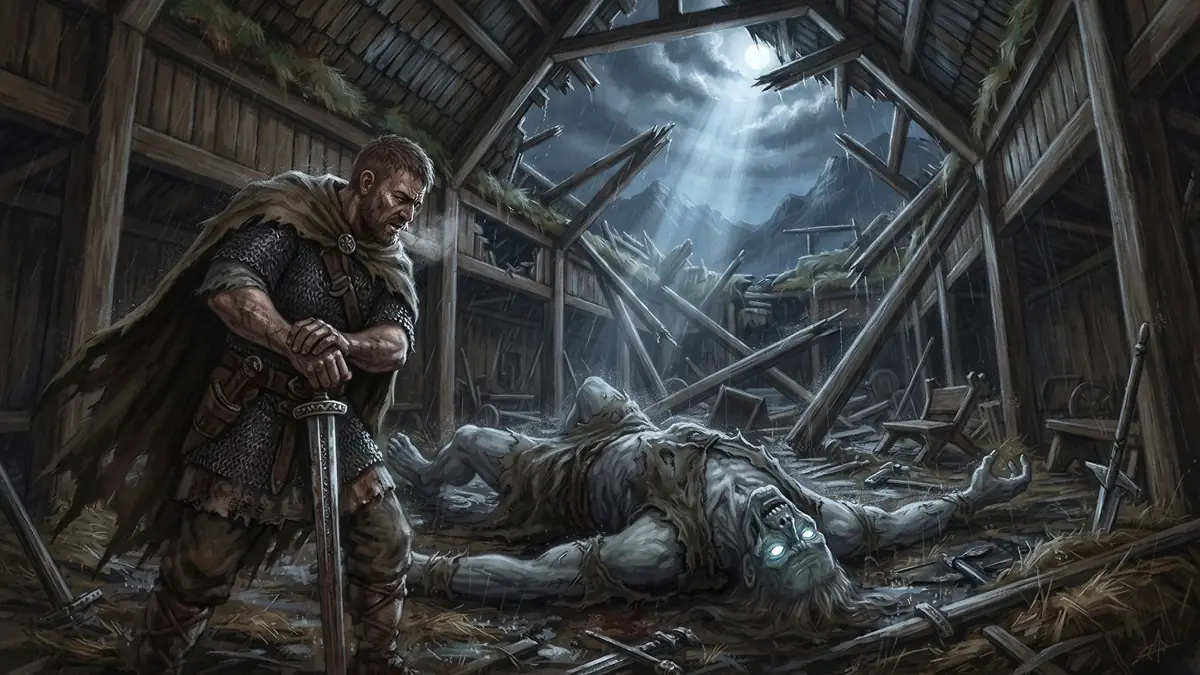
Among the sagas of the Icelanders, that of Grettir the Strong is the one that best shows what Icelanders feared in the dark. The hero spends almost twenty years as an outlaw, hunted by enemies and betrayed by those who shelter him, and the best-remembered scene of the saga is the fight against a dead man who refuses to stay dead.
A late saga
Grettis saga was written in the 14th century; the oldest manuscript is from shortly before 1400. The author is unknown, and may have drawn on an earlier account of Grettir’s life, attributed to Sturla Þórðarson. The saga narrates events said to have occurred between the 9th and 11th centuries. If it reflects reality, Grettir died between 1030 and 1040, but there is no independent proof that the episodes happened as written.
The shepherd who does not rest
The farmer Þórhall had shepherds who died one by one, victims of a creature that haunted the farm. He then hired the Swede Glámr, a big, strong man. Glámr drove the creature off, but he refused to fast on Christmas Eve and was found dead in the snow, the price of his victory. As no one could carry the body to the church, it was buried where it lay. Soon afterwards, he came back.
The fight
Grettir arrives at the farm and waits in the hall, wrapped in his cloak. Glámr enters, tears off the cloak, and the two wrestle through the hall and out the door. Grettir pushes Glámr until the dead man’s shoulders smash the door-frame and the roof collapses. Glámr falls on his back in the yard, and a cloud slides away from the moon. The dead man’s eyes, turned upward, glare at Grettir. It is the only sight that, by the hero’s own account, ever shook him. He is left without strength to draw his short sword.
Then Glámr speaks, and his speech is a curse. Grettir has gained, he says, only half the strength that was due to him, and will never be stronger than he is now. His deeds will bring misfortune and killings. He will be an outlaw and live alone, and will always see Glámr’s eyes, which will drive him to his death. Grettir recovers and cuts off the dead man’s head. The body is burned, the ashes are gathered in a hide and buried where few pass.
After the curse
What Glámr said comes true. Grettir becomes afraid of walking alone in the dark. From this comes an Icelandic proverb: whoever sees things crookedly has “Glámr’s eyes”. The saga ends on the island of Drangey, where Grettir is killed after the sorcery of his enemies.
What Glámr is
The text of the saga calls Glámr a troll, not a draugr, the undead of Norse tradition. Some scholars call him a draugr, because he brings together what is said of such beings: supernatural strength, the refusal to stay buried and the harm done to the living. What the saga clearly shows is a ghost whose strongest weapon is his gaze.
To face Glámr, play Glámr’s eyes.
Sources.
- Grettis saga Ásmundarsonar, chapters 32 to 35 (14th century), in the translation by William Morris and Eiríkr Magnússon, 1869
- Entry "Grettis saga", Wikipedia, for the dating and the manuscript history