Huldra: the beautiful forest woman who hides a cow's tail
In the folklore of Norway and Sweden, the huldra seduces men in the woods, but her tail and hollow back give her away. She can also be generous to those who treat her with respect.
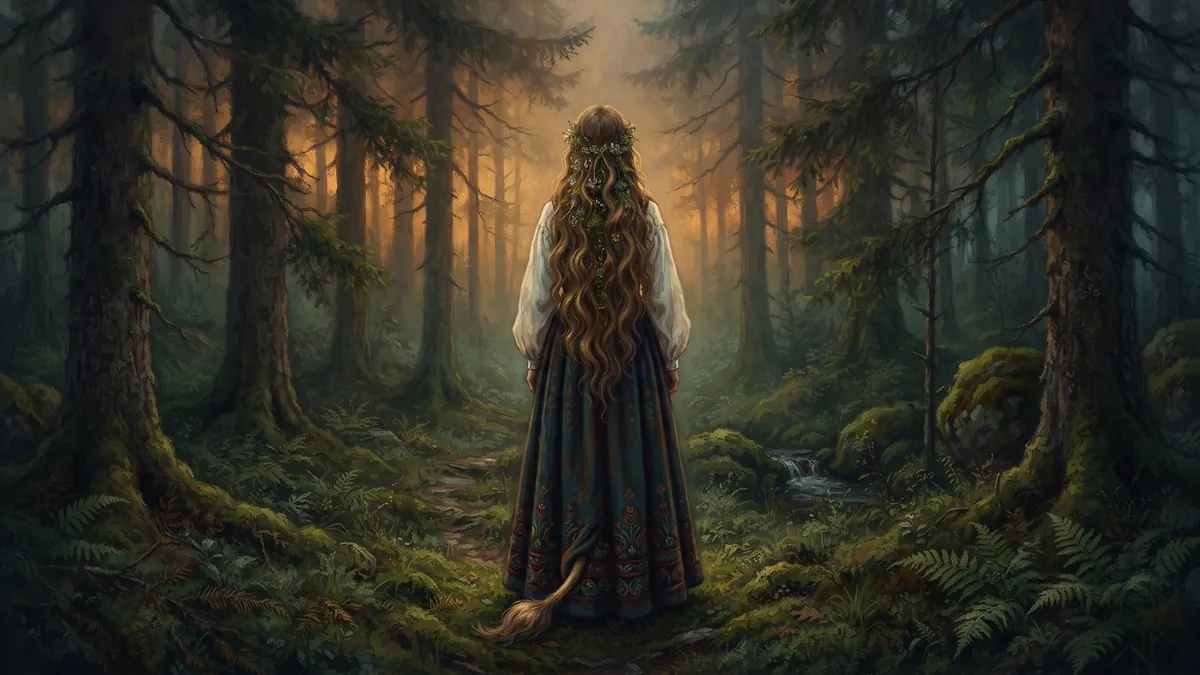
In Norway and Sweden, anyone who ventured into the forest or climbed the mountain might meet a woman of rare beauty, with long hair and a fine dress. If they paid attention, they would see what she hid: a cow’s or a fox’s tail, or a hollow back, like a rotten tree trunk. She is the huldra, a figure of Scandinavian folklore, and her stories were told for centuries before anyone wrote them down.
Who the huldra is
The name comes from the Norwegian form huldra. In Sweden, she is the skogsrå, “forest ruler”, or the tallemaja, “pine Maria”. Among the Sámi, she appears as the ulda. There is also a male counterpart, the huldrekall. The name is associated with a root meaning “covered” or “secret”, and some scholars relate it to Huld, a seeress figure, and to the German Holda, but that link is debated.
The huldrefolk, the “hidden people”, live in the mountains and woods, with their cattle and their farms, but out of sight of humans. The huldra is the one who appears most in the stories.
The seduction
The huldra tempts the men who pass by. She draws them with beauty, with music and with promises, and there are tales in which a young man marries one. The signs of her nature show beneath the long dress. The stories say the enchantment breaks when the young man sees the tail, or when she is treated gently and leaves the hidden life. There are versions in which the tail falls off after a baptism or a church wedding.
Older tales link the meeting to danger: whoever let himself be led could get lost in the woods or vanish.
The generous face
Not every story is dark. In several accounts, especially Swedish ones, the skogsrå is kind to charcoal burners: while they slept, she tended the kilns, and in return they left food for her. A tale from Närke, in Sweden, says she could be very kind if treated with respect. The opposite also holds: anyone who offended or scorned her could have bad luck in hunting, with cattle and in their work.
A relative of hers, the bergsrå, ruler of the mines, made life hard for poor miners.
From the countryside to books
In the 19th century, Peter Christen Asbjørnsen collected and published stories about the huldrefolk in Norway, at the same time that he and Jørgen Moe were gathering the country’s folk tales. These books helped fix the image of the huldra with a tail and a hollow back. Later studies, such as those of Gunnar Granberg in 1935 and Mikael Häll in 2013, show how varied the Swedish skogsrå tradition was and how it changed from region to region.
Today the huldra appears in books, in games and in place names: there are places in Denmark and Norway that bear her name, such as Huldremose in Jutland and, in Sámi lands, the mountain Ulddaidvárri, “mountain of the hulders”. The figure lives on, even without anyone needing to believe in her.
To find out who is hiding a tail, play Spot the tail.
Sources.
- Peter Christen Asbjørnsen, collections of tales and legends about the huldrefolk (1840s)
- Gunnar Granberg, *Skogsrået i yngre nordisk folktradition*, 1935
- Mikael Häll, *Skogsrået, näcken och djävulen*, 2013