Stiklestad, 1030: the battle in which King Olaf died and Norway's saint was born
Olaf Haraldsson fell before Norwegian chieftains who backed King Cnut. Snorri says the sun darkened, but the date of the battle and that of the eclipse do not match.
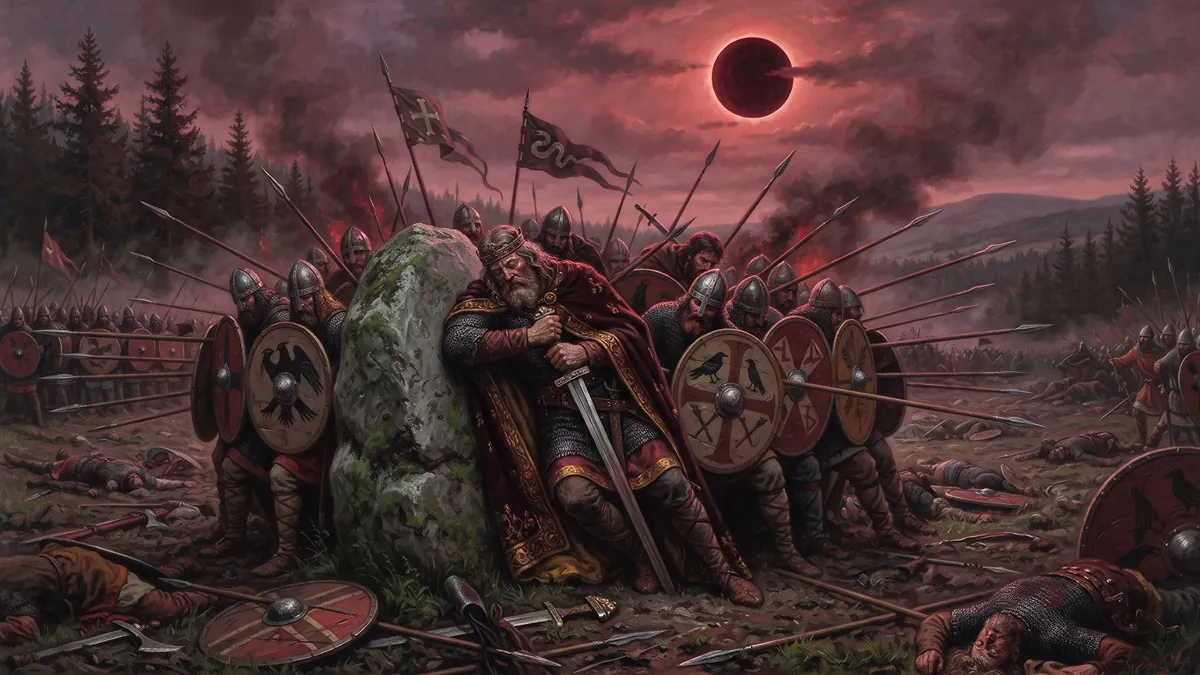
In 1030, in central Norway, King Olaf Haraldsson was killed in a battle at Stiklestad. The defeat cost him the throne and, the following year, made him a saint. Almost everything told about the day comes from Snorri Sturluson, who wrote the Heimskringla about two centuries later, and there are passages that history does not confirm.
Who fought
On one side were Olaf, his guard, Swedish auxiliaries sent by King Anund Jacob and the Norwegian exile Dagr Hringsson. On the other, a “farmer army”: Norwegian chieftains and landowners loyal to Cnut the Great, led by Þórir hundr, Kálfr Árnason and Hárek of Tjøtta. Kálfr had once served Olaf. Among those on the king’s side was his half-brother Harald Hardrada, then fifteen, who was wounded, fled and was hidden by local people. He would become king of Norway and die at Stamford Bridge in 1066.
Snorri gives numbers: 3,600 men for Olaf and “a hundred hundreds”, or 14,400, for the farmers. Historians consider the real sizes impossible to know.
The king’s death
According to Snorri, Olaf received three severe wounds. Torstein Knarresmed of Rovde wounded him above the left knee and was killed immediately after. Kálfr struck him in the neck. Þórir drove a spear into his belly while the king was leaning against a large stone. The sources older than Snorri do not say who dealt each blow.
The body was buried in secret, on the sandy bank of the Nidelva river, near Trondheim. Snorri says that, a year later, the body was found uncorrupted and taken to St Clement’s church. Bishop Grimkell, whom Olaf had brought from England, began the cult. Formal canonization by the Catholic Church came only in 1164. Nidaros Cathedral was raised later over the grave, and the silver reliquary holding the remains was melted down in the 16th century. Where the remains are, no one knows.
The darkened sun
Snorri writes that, on the day of the battle, the sun turned “red as blood”, an omen. Tradition fixes the battle on 29 July 1030. But the solar eclipse that can be calculated for that year was on 31 August, around two in the afternoon. The two dates do not coincide, and those who wrote later may have tied the eclipse to the battle on their own. The question remains open.
What was added
Per Sivle’s poem of 1901 brought in the standard-bearer Tord Foleson, whose banner stayed raised after the king fell. A monument, the Olavsstøtta, was put up in 1807, and since 1954 the play Saint Olav Drama has been staged every July at Stiklestad. None of this is in Snorri, but it helps explain why the battle remains alive in Norwegian memory.
To hold the line until the sun darkens, play Hold the line at Stiklestad.
Sources.
- Snorri Sturluson, *Heimskringla*, the saga of King Olaf the Saint (c. 1230)
- Entry "Battle of Stiklestad", Wikipedia, with reference to the NASA eclipse catalogue