Valkyries and Valhalla: whom Odin and Freyja receive among those slain in battle
The poems of the Edda describe a hall of spears and shields where warriors fight by day and feast at night. Who chooses the dead, and how much of the popular image was invented later?
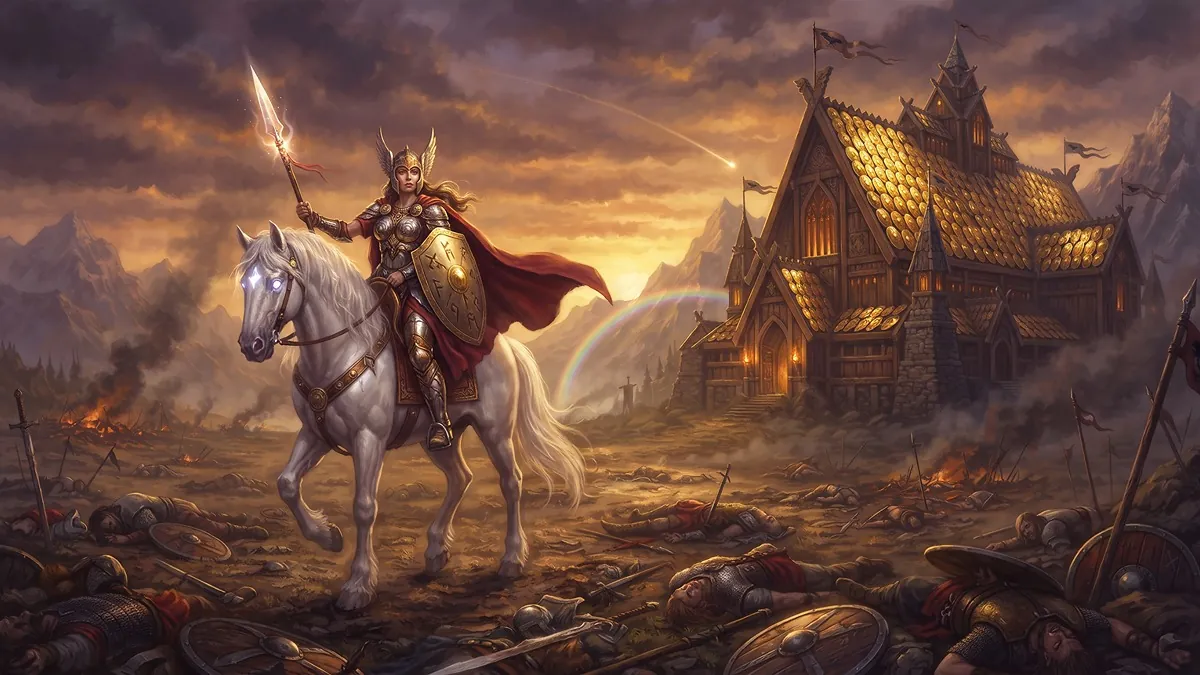
For the Norse poets, dying with a weapon in your hand could be the start of another life in a great hall. The hall is called Valhalla, “hall of the slain”, and those who decided who entered it were gods and women on horseback, the valkyries. The sources that tell this are poems of the Edda and the text of Snorri Sturluson, written centuries after people stopped believing in these things, and not everything said about the subject today comes from them.
The hall
The poem Grímnismál describes Odin’s hall: the rafters are spears, the roof is covered with shields. It also says the hall has 540 doors and that eight hundred warriors will go through each of them when they march against the wolf Fenrir at Ragnarök. These warriors are the einherjar, “those who fight alone”. According to Vafþrúðnismál, they fight every day, kill one another and, at nightfall, return whole to the table.
The feast has a fixed menu. Grímnismál says the cook Andhrímnir prepares the boar Sæhrímnir in the cauldron Eldhrímnir, and that the goat Heiðrún, grazing on the branches of a tree beside the hall, fills vats with mead. Those who serve the drink, in the same poem, are the valkyries.
The valkyries
Valkyrja means “chooser of the slain”. In Gylfaginning, Snorri writes that Odin sends them to every battle to choose who dies and to decide victory. Grímnismál names figures such as Hrist and Mist. In Njáls saga, the poem Darraðarljóð shows twelve valkyries weaving, on a loom of horrors, the fate of a battle, the one at Clontarf, in Ireland, in 1014.
The sources do not paint a simple picture. In Lokasenna, Loki accuses Odin of sometimes giving victory to someone who did not deserve it. Odin, then, is not an impartial judge: he picks those he wants at his side before the end of the world.
Freyja and Fólkvangr
Valhalla is not the only destination. Grímnismál, stanza 14, says Freyja rules Fólkvangr, “field of the people”, and that, of those slain in battle, “half she chooses each day, and half Odin owns”. The reading is debated. Some scholars understand that Freyja really receives half of the dead. Others read “choose” as the act of deciding who will die, and think the fallen all end up in Odin’s hall. The text, as it has reached us, allows both readings.
What came afterwards
The image of fair-haired women in winged helmets flying over the battlefield comes in large part from the 19th century, from Romantic art and from Wagner’s opera Die Walküre, first staged in 1870. In the old sources, valkyries appear also as warrior women and as servants of the hall, and the idea that only those who died in combat went to Valhalla is a simplification: the sources have exceptions.
To choose who goes to each hall, play The valkyrie’s choice.
Sources.
- Grímnismál, Vafþrúðnismál and Lokasenna, in the Poetic Edda (13th-century manuscripts)
- Snorri Sturluson, *Gylfaginning*, in the Prose Edda (c. 1220)
- Njáls saga, with the poem Darraðarljóð (13th century)