Soria Moria: the castle every Norwegian seeks without ever having seen it
In a tale by Asbjørnsen and Moe, the lad Halvor sails to a golden castle, beats trolls and marries a princess. The name became a synonym for perfect happiness and longing.
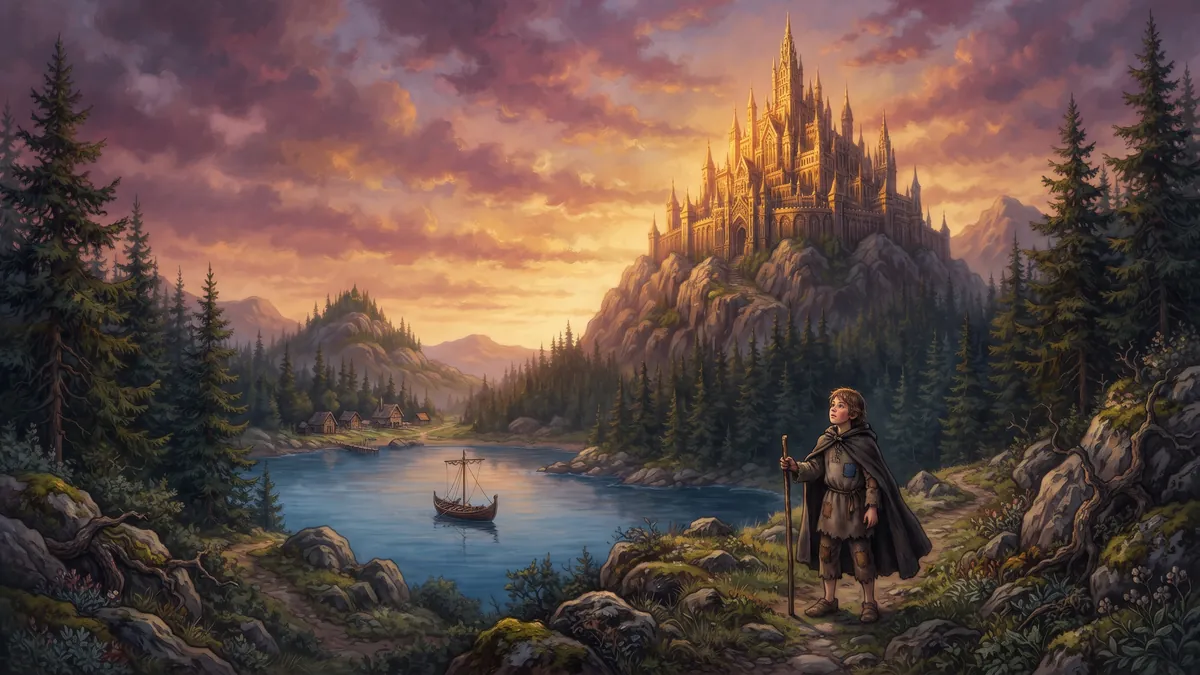
Few Norwegian names carry as much longing as Soria Moria. It is the castle of a folk tale collected by Peter Christen Asbjørnsen and Jørgen Moe, the folklorists who did for Norway what the Brothers Grimm did for Germany. The tale appears in the Norske Folkeeventyr and was translated into English by Andrew Lang, in The Red Fairy Book of 1890.
The lad of the ashes
The hero is Halvor, who, like the Askeladden of other tales, lives by the hearth and moves only when someone forces him to. One day he sees a ship arrive and, without much thought, sails away on it. A storm carries him to an unknown land, where he comes to a castle.
The castle and the trolls
In the castle lives a princess held prisoner by a three-headed troll. Before facing it, Halvor drinks from a flask and gains superhuman strength, which lets him wield a sword too heavy for an ordinary man. He beats the troll and frees the girl.
The adventure repeats. He saves two other princesses, held by trolls with six and nine heads. The three girls become his travelling companions, and he marries the youngest.
The ring and the return
The princess gives Halvor a ring able to grant wishes. But he falls into forgetfulness, and the sisters, using the ring, have themselves carried back to the castle. To reach the castle, Halvor needs magic boots and the west wind, and only when a ring is recognised in a cup is he recognised as well. The tale ends with the reunion.
Soria Moria, the place
The name Soria Moria became more than the castle of the tale. In 1881, the painter Theodor Kittelsen made his famous version of the castle, an image that spread across Norway. It came to stand for an ideal of perfect happiness, a place of longing that no one knows the whereabouts of.
Where the name has travelled
The word reappears in many places. The writer Ole Edvart Rølvaag wrote The Boat of Longing in 1933, linking the search for a better place to Norwegian emigration. The singer Sissel recorded a song about the castle in 1989. The musician Mount Eerie released an album in 2017 on the theme, and the Soria Moria Declaration, of 2005, was the agreement of a Norwegian government. The writer Tolkien said the sound of the name inspired him to create Moria.
As with every fairy tale, the source is not a single one: Asbjørnsen and Moe collected and rewrote the stories, and what they heard was already a mixture of traditions. For a quest tale like this one, that mixture seems almost fitting.
To find the way to the castle, play To Soria Moria.
Sources.
- Asbjørnsen and Moe, Norske Folkeeventyr (Norwegian folk tales)
- Andrew Lang, The Red Fairy Book (1890)
- Encyclopedia entries on Soria Moria and Theodor Kittelsen