Ibn Fadlan and the Rus' of the Volga: the Baghdad diplomat who described the Vikings
In 921–922 an envoy of the caliph travelled to the Volga and met merchants whom most scholars consider Scandinavian. His account includes tattoos, rituals and a ship funeral.
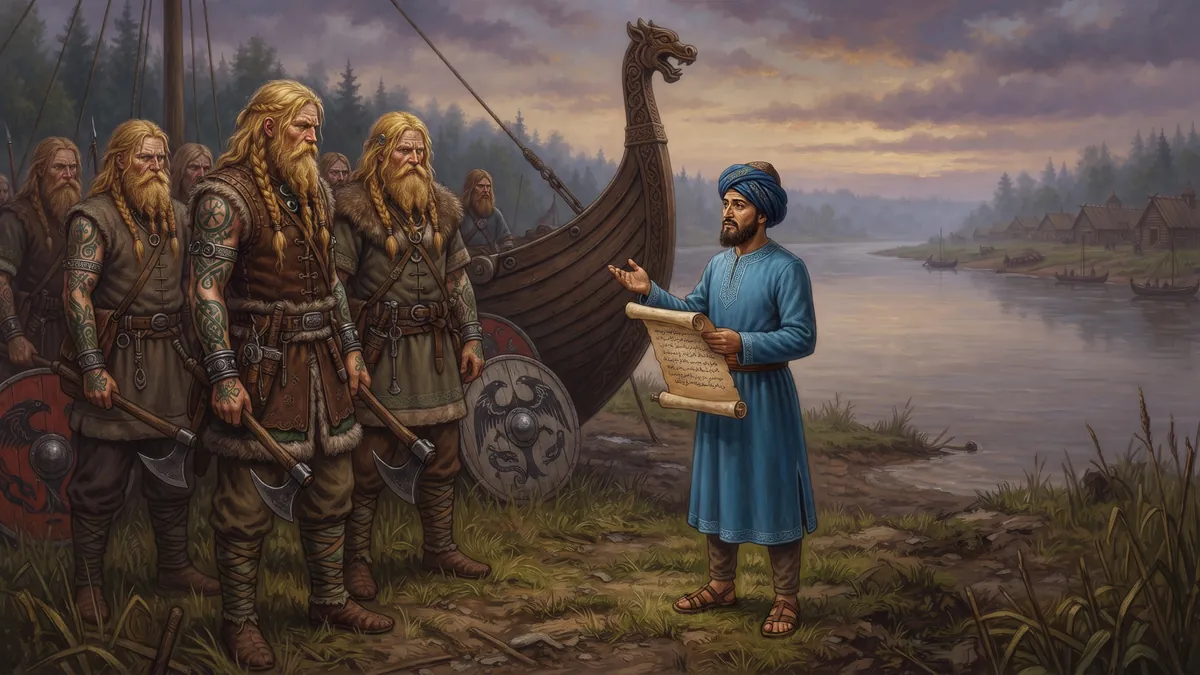
Most of what is known about the Vikings comes from the Norse themselves or from their Christian victims. There is one famous exception: Ahmad ibn Fadlan, an official of the caliphate of Baghdad, who set out in 921 on a diplomatic mission and ended up describing, with a foreigner’s eye, Northern men he met on the banks of the Volga.
The mission
Caliph al-Muqtadir sent Ibn Fadlan to the king of the Volga Bulgars, who had asked for help to learn the Islamic religion and to build a fortress. The journey was long. The caravan left Baghdad in June 921, crossed Persia and Central Asia and reached the Bulgar kingdom in May 922.
Ibn Fadlan’s account, the Risala, describes peoples, foods and customs with curiosity, and sometimes with disgust. He covers Turks, Khazars and other peoples, but it is the part about the Rus’ that became best known.
Who the Rus’ were
Ibn Fadlan calls Rus’ the merchants he met, camped by the river to sell enslaved people and furs. Today, most scholars consider them Scandinavians, or linked to them, travelling the rivers of eastern Europe. But the identification is not unanimous, and the text itself does not use the word “Viking”.
According to the account, they were tall, “like palm trees”, fair-skinned with blond or red hair. Each carried an axe, a sword and a knife. The men’s bodies were covered in dark green designs running from fingernails to neck. The women wore brooches on the chest and bead necklaces.
Customs that shocked
Ibn Fadlan found the Rus’ dirty. He said that in the morning everyone washed face and hair in the same basin of water, passed from one to another, and blew their noses in it. He also described prayers to wooden idols, to which they offered food and asked for good trade.
The most famous passage is the funeral of a chief. According to the account, the body was kept for ten days while the clothes were prepared. A young enslaved woman volunteered to die with the chief and was killed in a ceremony inside a tent on the ship, which was then burned.
How much to believe
The text is one of the richest direct sources on Viking Age funeral rituals, but it has limits. Ibn Fadlan did not speak the Rus’ language and needed interpreters. He wrote as a Muslim, judging the scene by his own values. And the account has reached us in later copies, not the original.
Archaeologists have found ship burials in Scandinavia and elsewhere, which gives some support to the general picture. But none confirms, point by point, the ritual described.
The diplomat and the film
The account inspired novel and film, including a Hollywood version with monsters that do not appear in the text. The real version is less colourful, and more interesting: a man from Baghdad, with a keen eye, who saw Northern men far from home and wrote down what he saw.
To separate what the chronicler wrote from what was invented later, play Ibn Fadlan’s account.
Sources.
- Risala (travel account) by Ahmad ibn Fadlan, 921–922, in modern editions and translations
- Encyclopedia entries on Ibn Fadlan and the Rus'
- Studies on the origin of the Rus' and funeral rituals in Eurasia