Kópakonan: the seal woman of Mikladalur, a legend from the Faroe Islands
In Faroese tradition, a man from Kalsoy steals the skin of a seal that was dancing in the shape of a woman. She lives for years on land, until she finds the skin and returns to the sea.
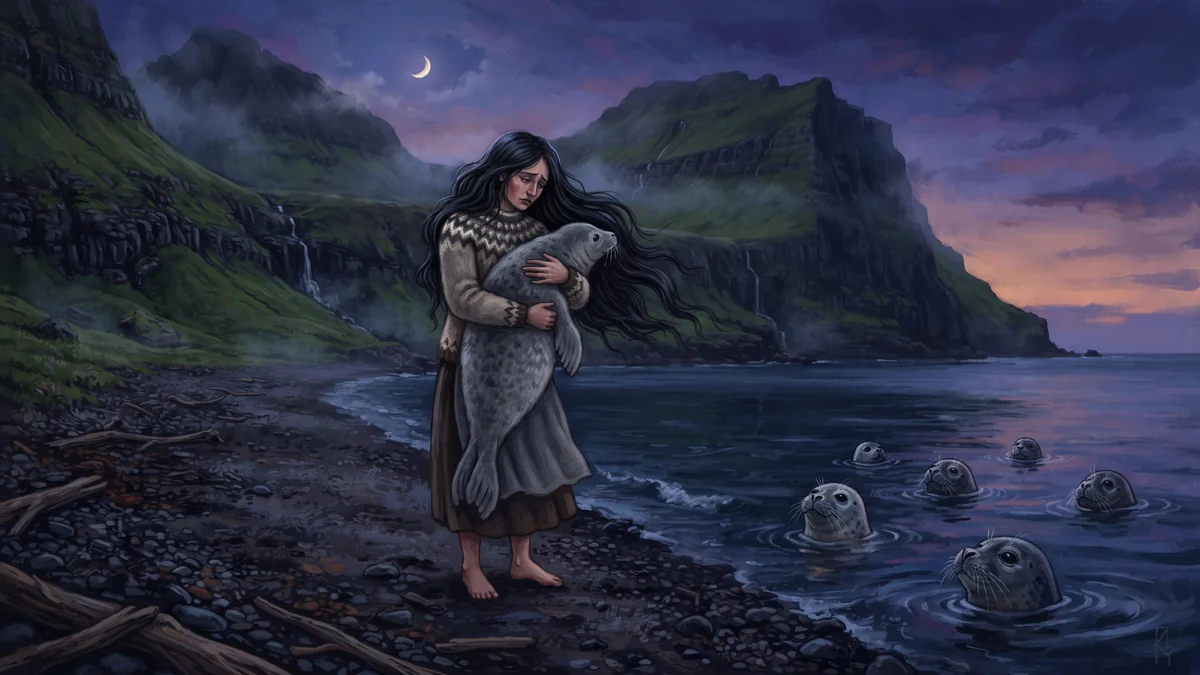
On a winter night, on a beach on the island of Kalsoy, in the Faroe Islands, seals come out of the sea, take off their skins and dance in the shape of women. That is what the legend of the seal woman, the Kópakonan, tells.
The legend of Mikladalur
According to tradition, a man from the village of Mikladalur spied on the dance and hid one of the skins. When day broke, the other seals returned to the sea, but one of them, without her skin, stayed on land in the shape of a woman.
The man took her home and married her. They had children, and for years she lived on land, but she kept a sorrow her husband did not understand.
The skin returned
One day, while he was out at sea, she found the hidden skin. She said goodbye to the children, put on the skin and went back into the water. In some versions, the men of the place end up killed by seals, in revenge. In others, she simply returns to the sea and watches her children from afar.
The versions vary, and the ending changes from teller to teller. There is no single form of the legend.
What the story says
The legend speaks of an abduction and of longing. The woman is torn from her world by an act of deceit, and spends years in a place that is not hers. For those who heard the story it also served as a warning: the sea has its masters, and what is taken from it may exact a price.
Similar legends exist in several parts of the North Atlantic: in Orkney, Shetland, Scotland, Ireland and Iceland. In English, seal women are called selkies.
A statue by the sea
In Mikladalur, a bronze statue, unveiled in 2014, shows the seal woman midway through transformation, with the skin still on her shoulders. The legend has become one of the best-known images of the Faroe Islands.
The ballad and the statue
The Mikladalur statue is the work of the Faroese sculptor Hans Pauli Olsen, and shows the seal woman still in transformation, between the two shapes. Outside the Faroes the theme also became song: The Great Silkie of Sule Skerry, a ballad from Orkney, was catalogued by the scholar Francis James Child in the nineteenth century as number 113. In it a seal man visits a woman on land and leaves a son. The idea of a being between two worlds runs through the versions.
To guide the seal through the deep to the skin that awaits her, play The sealskin.
Sources.
- Collections of Faroese folklore from the 19th and 20th centuries
- Studies on seal and selkie legends in the North Atlantic