Odin and the mead of poetry: the theft that gave poets their art
In the Prose Edda, Odin disguises himself, wins over the guardian Gunnlöð and drinks all the mead that held the poets' wisdom. Then he flees, flying as an eagle.
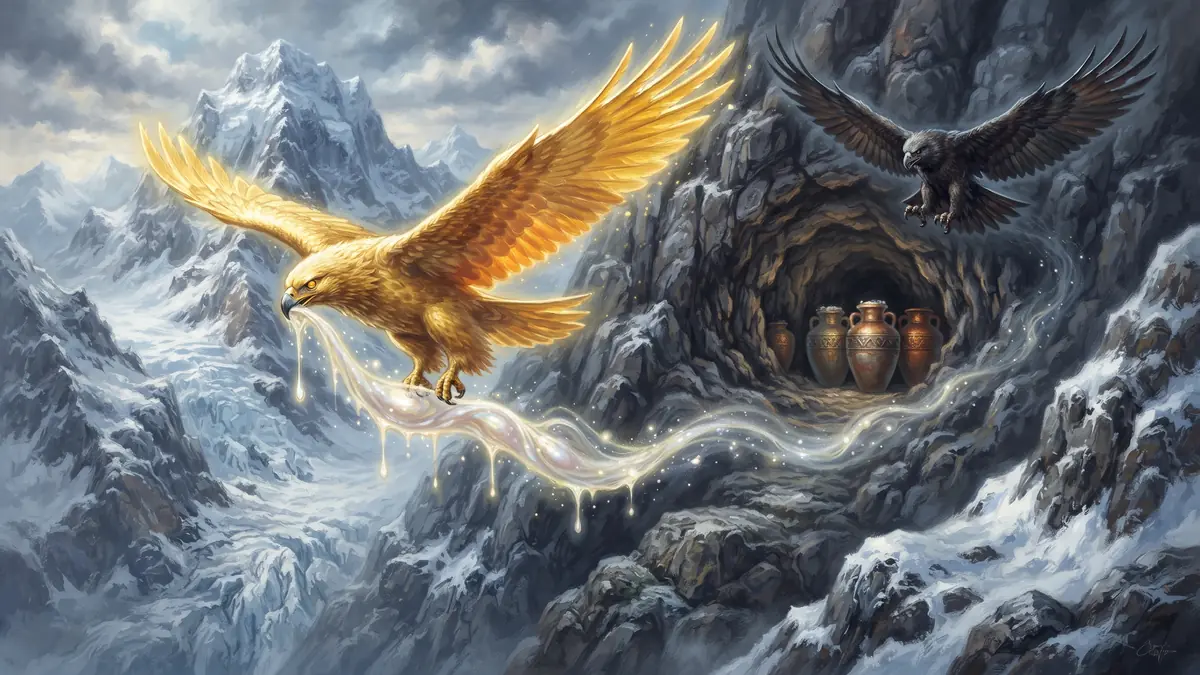
Odin wanted to drink what no god or giant should have: the mead that gave anyone who tasted it the gift of poetry and wisdom. To get it, he used disguise, seduction and an escape as an eagle.
The blood of Kvasir
According to Snorri Sturluson, the gods, the Æsir and the Vanir, sealed the peace after a war by spitting into the same vessel. From that mixture was born Kvasir, the wisest being of all. Two dwarfs, Fjalar and Galar, killed him and mixed his blood with honey. The result was kept in three containers: Óðrerir, Boðn and Són. Whoever drank the mead would become a poet or a sage.
The giant Suttung
The dwarfs ended up handing the mead to the giant Suttung as payment for a death they had caused. Suttung hid it inside the mountain Hnitbjörg and set his daughter, Gunnlöð, to guard it.
Odin’s disguise
Odin arrived as a wanderer called Bölverk and had Suttung’s brother, Baugi, drill a path through the rock with an auger called Rati. Odin turned into a snake and entered through the hole. Inside, he spent three nights with Gunnlöð and won the right to three draughts. With each draught he emptied one of the containers.
The Hávamál tells the episode in Odin’s own voice, and he admits he deceived the guardian. It is a passage in which the god appears as cunning, not as just.
The escape
Odin became an eagle and flew off, with Suttung, also as an eagle, behind him. The gods set out vessels at the edge of Asgard, and Odin spat the mead into them. A little fell behind, and Snorri says that remainder was left to bad poets, while the mead inside the vessels belongs to the true ones.
What the story explains
The myth gives a divine origin to the skalds’ art. Norse poets called poetry “Odin’s mead”, “Kvasir’s blood” or “Odin’s cargo”, and Snorri uses the episode to explain those expressions, which we call kennings.
Names that say a lot
The names in the myth carry meaning. Óðrerir, the name of the main vessel, can be read as “the one that stirs inspiration”, since óðr means fury but also poetic inspiration, and comes from the same root as Odin’s name. Bölverkr, the god’s disguise, means something like “evildoer”. Snorri thus shows an Odin who seeks poetry by cunning, not merit, which fits the god’s image in the sources: wise, but hardly trustworthy.
To drink the three draughts without spilling, play The three draughts.
Sources.
- Snorri Sturluson, *Prose Edda*, sections *Skáldskaparmál* and *Gylfaginning* (around 1220)
- *Hávamál*, in the Poetic Edda, stanzas 104 to 110 (Codex Regius manuscript, around 1270)