Rígsþula: how Heimdall, in disguise, visited three houses and gave rise to the orders of society
In the poem Rígsþula, Heimdall walks the earth as Ríg and passes through three houses. From each visit a social order is born: the thrall, the farmer and the jarl.
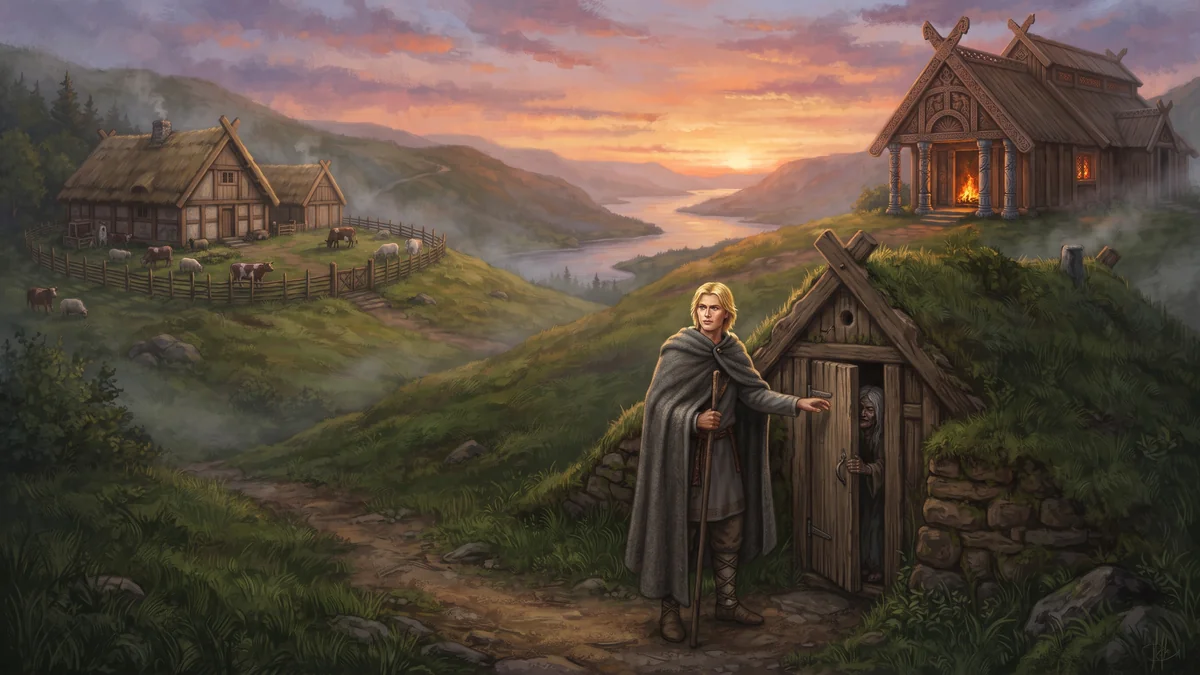
A traveller walks along the shore and knocks at the door of a poor house. He is Heimdall, who in the poem uses the name Ríg, and what he does in three houses explains where three classes of people come from.
An incomplete poem
The Rígsþula, the “Song of Ríg”, is an Old Norse poem preserved in a single 14th-century manuscript, the Codex Wormianus, and it breaks off in the middle. Specialists debate when it was composed. Some place it around the year 900 and others much later. The name Ríg may come from a Celtic word for “king”, but that is a hypothesis.
The three houses
In the first live Ái and Edda, a poor couple, in a low hut with coarse bread. Ríg sits between them, sleeps with them, and nine months later Þræll is born, the thrall, described as dark-skinned and rough-handed. The poem goes on with his children, whose names, in the original, are unflattering.
In the second live Afi and Amma, who weave and carve. The food is better, and Karl is born, the free farmer, red-haired and active. He builds houses and ploughs the land.
In the third live Faðir and Móðir, in a well-kept hall with a full table and fine clothes. Jarl is born, the nobleman, fair-haired, who learns to use weapons and the knowledge of runes.
The son who becomes king
Ríg returns, adopts Jarl and teaches him the runes. Jarl’s youngest son is called Konr ungr, “Konr the Young”, and surpasses Ríg himself in knowledge. The name Konr recalls the word konungr, king, and the poem seems to suggest that kingship springs from here. The text breaks off at that point.
How to read the poem
The Rígsþula shows how a medieval author imagined Norse society, divided into thralls, free people and nobles. The poem reflects an order that existed, with enslaved people and hierarchies of power.
Extremist groups have tried to use the poem’s physical descriptions to justify racial hierarchies. Scholars reject that reading: the text speaks of social classes, and the colours serve as poetic imagery, not as a theory of races.
The sons of Heimdall
The link between Heimdall and humankind appears outside the Rígsþula. The Völuspá opens by asking silence of the “sons of Heimdall”, understood as human beings. The prose introduction to the Rígsþula, which may have been added later, identifies Ríg with Heimdall. For medieval readers, then, the god who guarded the bridge was also a kind of symbolic father of men, which helps explain why the poem chooses him to visit the houses.
To give each family the right house, play The three houses.
Sources.
- *Rígsþula*, Old Norse poem preserved incompletely in the Codex Wormianus manuscript (around 1350)
- Snorri Sturluson, *Prose Edda* (around 1220), on Heimdall