Magnus of Orkney: the earl who refused to fight and was killed on the island of Egilsay
According to the Orkneyinga saga, Magnus Erlendsson was killed on his cousin Hákon's orders at a peace meeting. A find in 1919 may have revealed his bones.
Among the Orkney Islands, north of Scotland, an earl of the 12th century became known for something rare among the nobles of his age: he refused to fight. His name was Magnus Erlendsson, and his story reaches us through the Saga of the Orkney Earls (Orkneyinga saga).
Written in Iceland
The saga was composed in Iceland around 1200, almost a century after the events. It tells the story of the earls who ruled Orkney, islands that belonged to the Norse world and passed to Scotland only in the 15th century. What it says about Magnus is a tradition, and many details are not confirmed by other sources.
The earl who sang psalms
According to the saga, Magnus was forced to accompany the Norwegian king Magnus Barefoot on an expedition through the Irish Sea in 1098. When the battle began, he refused to fight, saying he had no quarrel with anyone. He stayed in the ship’s hold, reading psalms, while others fought. Later, he fled to Scotland.
Years later, he returned to Orkney and came to govern the islands with his cousin, Hákon Pálsson. For a time, the two shared power. Relations worsened, and the followers of each grew suspicious.
The meeting at Egilsay
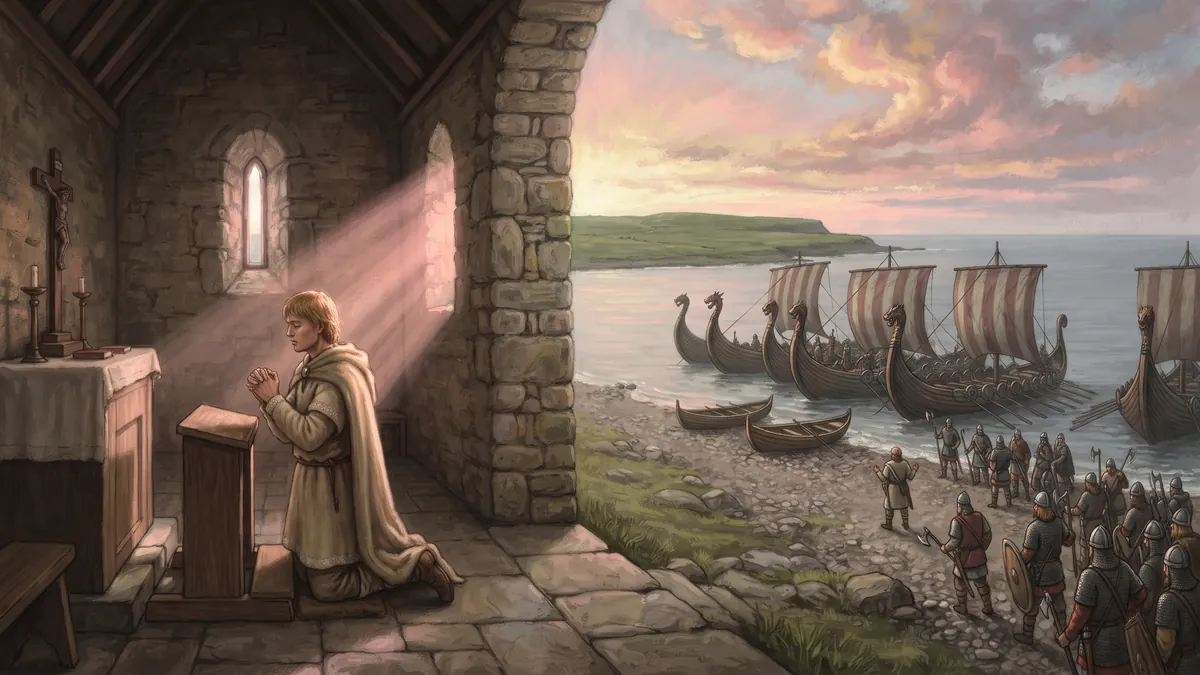
To make peace, the earls arranged a peace meeting, at Easter, on the small island of Egilsay. Each was to arrive with two ships. Magnus kept the agreement. Hákon appeared with eight, according to the saga.
That night, Magnus prayed in the island’s church. The next morning, he proposed to be exiled or imprisoned instead of being killed. Hákon refused. Hákon’s standard-bearer, Ofeigr, refused to kill the earl. The cook Lifólfr was forced to do it. Tradition dates the death to 1117, or 1116, and says Magnus asked to be struck on the head, and prayed for his killers.
The saint and the bones
Magnus was recognised as a saint, and his nephew Rögnvaldr Kali Kolsson began the cathedral that bears his name in Kirkwall, in 1137. In 1919, during works, workmen found inside a pillar a box with bones. The skull has a deep wound, consistent with an axe blow. Many accept it as the earl, and others urge caution.
According to tradition, the story became an example of courage without violence. For scholars, it is also a portrait of the conflict between two chieftains.
What the saga wants to teach
The saga is, in part, a tale of sanctity. The medieval authors wanted to show that Magnus was pious and that his death was a martyrdom, and so they stress humility, prayer and forgiveness of the killers. That does not mean everything is invented, but it helps to read the text with care. There are versions of Magnus’s life, in Old Norse and in Latin, and they differ in details. His feast is remembered on 16 April, and the cult spread across Orkney and beyond.
To count how many ships Hákon brought to the island before the meeting begins, play Magnus’s ships.
Sources.
- Unknown author, *Orkneyinga saga*, the Saga of the Orkney Earls (around 1200, written in Iceland)
- Archaeological studies of the remains found in 1919 in St Magnus Cathedral, Kirkwall