Clontarf, 1014: the Good Friday battle in which Brian Boru died, and why it was not just Irish against Vikings
In 1014, near Dublin, the High King Brian Boru died after winning the battle of Clontarf. See what the Irish and Norse sources say and why the picture of Irish against Vikings is too simple.
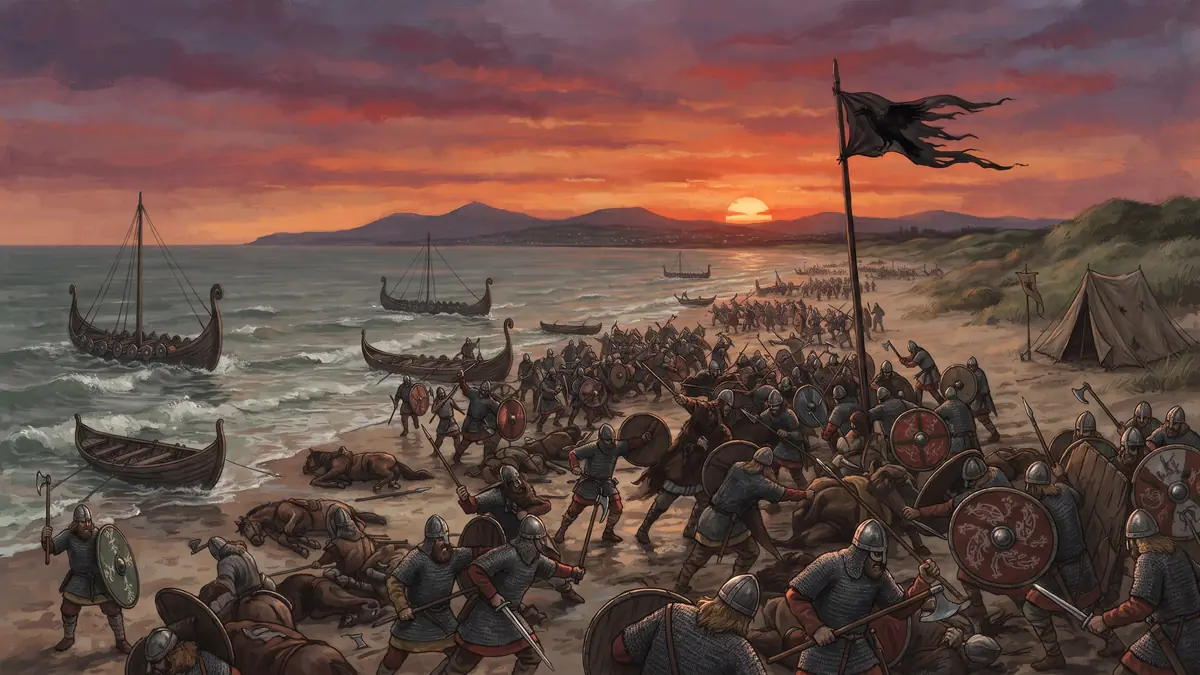
The battle of Clontarf took place on Good Friday, 23 April 1014, near Dublin. It became famous in Ireland as the moment when Brian Boru, the High King, defeated the Vikings and died. The reality, according to historians, is more complicated than that picture.
Dublin and its neighbours
Dublin was founded as a Viking base in the 9th century and, around 1014, was a Norse-speaking kingdom ruled by Sigtrygg Silkbeard. The city was tied to the neighbouring Irish kingdoms by trade, marriages and alliances. Brian Boru, king of Munster, had won the title of High King of Ireland, and several other kings resisted him.
Among the discontented was Máel Mórda, king of Leinster, Sigtrygg’s maternal uncle. That alliance led to the battle. Sigtrygg and Máel Mórda asked for reinforcements from abroad. Sigurd Hlodvirsson, earl of Orkney, came and, according to the saga, a chief called Brodir, from the Isle of Man.
The battle
The Annals of Ulster and the Annals of Inisfallen record a bloody battle at Clontarf, with many deaths on both sides. The Vikings and their Leinster allies lost. Brian’s son Murchad and his grandson died, and Sigurd too. Brian, who in his seventies had stayed in the campaign tent, was killed by Brodir, who was fleeing, according to tradition. Brodir himself was killed afterwards.
Njáls saga, written in the 13th century, devotes chapters to the battle. It tells that Sigurd carried a banner with a raven, woven by his mother, which guaranteed victory to those who followed it but death to the standard-bearer. The Orkneyinga saga repeats this story. It is a literary tradition, with no independent proof.
Who wrote the history?
The Cogad Gáedel re Gallaib, “The War of the Irish with the Foreigners”, was written in the early 12th century and favours Brian’s descendants. Scholars see in it a work of propaganda, which exaggerates the role of the Norse as enemies and makes Brian a national hero. The annals, closer to the events, show that both sides were mixed, with Irish and Norse both among Brian’s allies and among his enemies.
What remained
Most current historians see Clontarf less as a war of liberation against invaders and more as an episode in a political dispute between Irish kings, in which the Norse of Dublin were one of the parties. Dublin stayed Norse for a long time afterwards, and Brian’s death did not give his dynasty the dominion he had wanted.
Omens and succession
The saga tells that, on the morning of the battle, a man in Caithness saw women weaving on a loom made of weapons and entrails and singing the poem Darraðarljóð, which announces the fight. It is a literary episode, with no proof that it happened. The annals, for their part, suggest that the victory came at a high price: Brian’s death opened a dispute over the succession, and the idea of a strong High King was slow to return.
To try to sink the ships fleeing with the tide at Clontarf, play The tide at Clontarf.
Sources.
- *Annals of Ulster* and *Annals of Inisfallen* (medieval Irish records, entry for the year 1014)
- *Cogad Gáedel re Gallaib* (Irish text of the early 12th century, favourable to Brian's family)
- *Njáls saga* (*Brennu-Njáls saga*, chapters on Clontarf, 13th century) and *Orkneyinga saga*