Agnete and the merman: the Danish ballad of the woman who lived at the bottom of the sea
In the Danish ballad "Agnete og Havmanden", a young woman follows a merman to the sea floor and lives there for years, until she hears the bells of a church. Here is the ballad and its long life.
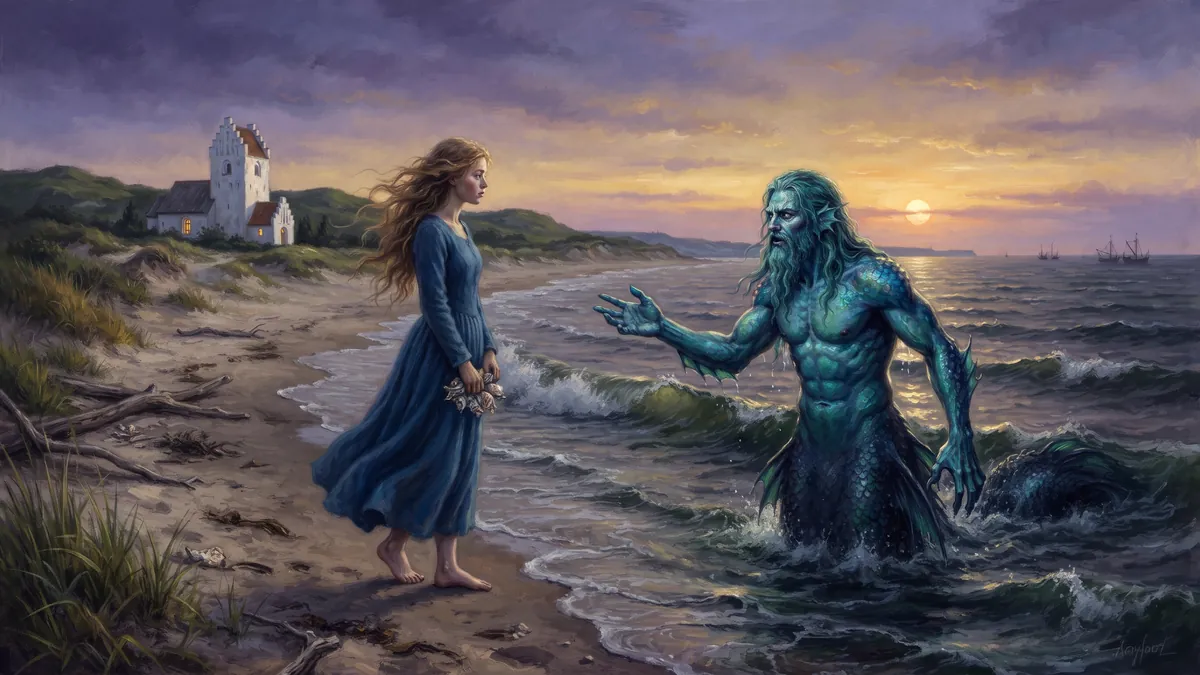
Before Denmark had books of folklore, there were songs sung and danced in a ring. One of these ballads tells the story of a young woman, a being of the sea and a church, and it crossed centuries and borders.
The ballad
Called Agnete og Havmanden, “Agnete and the Merman”, the ballad was recorded by Svend Grundtvig in the collection Danmarks gamle Folkeviser, which began to be published in 1853, from popular songs and older manuscripts. In outline, the plot is this: Agnete is walking on the beach when a merman appears. He invites her to the bottom of the sea. She accepts and follows him.
In the versions that have reached us, she lives on the sea floor for several years, commonly eight, and has children with him, often seven. One day she hears the bells of a church in the distance and longs for the land. She asks the merman to let her go to church, and he agrees, on condition that she returns.
The choice
Here the versions diverge. In many, Agnete goes up to the church, and when she leaves it, she does not go back. The merman calls to her from the sea, and she, moved or torn, stays on land. In others, the song ends with a lament from the sea being. What remains constant is the contrast between two worlds: that of the sea floor, which took her in, and that of the land, with the church and the neighbours.
Scholars classify the ballad among the ballads of supernatural beings in the Scandinavian repertoire, and note that it circulated in several countries, with variants. The bells as a call to the Christian and human world also appear in accounts of the mountain folk.
A story with a long life
One of the names that helped bring the story to an English-speaking public was the poet Matthew Arnold. In 1849 he published “The Forsaken Merman”, a poem that retells the plot from the merman’s perspective, left with his children. The original ballad is earlier, and is the starting point.
Today the story is read as a narrative about the choice between belongings. What exactly the original text says depends on the version. That is common in oral ballads, which change with every singer.
The sea beings of Scandinavian traditions take varied forms. The havmand and the havfrue, in the Danish names, appear in coastal ballads and legends, and some of these stories deal with encounters between people and sea creatures, which rarely end well for one side. The ballad of Agnete draws attention because, for many readers, it gives voice to longing for the land, and because the final choice is a woman’s, not an imposed fate.
To gather the treasures of the sea floor, swapping neighbouring pieces until three alike line up, like someone seeking a path between two worlds, play Treasures of the sea floor.
Sources.
- Svend Grundtvig (ed.), *Danmarks gamle Folkeviser* (1853 onward), ballad "Agnete og Havmanden"
- Bengt R. Jonsson et al. (eds), *The Types of the Scandinavian Medieval Ballad* (Scandinavian University Press, 1978)
- Matthew Arnold, "The Forsaken Merman" (1849)