Örvar-Oddr and the horse Faxi: the hero who buried his horse to escape a prophecy
In the Örvar-Odds saga, a seeress says the hero will die because of his horse Faxi. He buries the animal and travels the world for many years, but the prophecy waits for him at home.
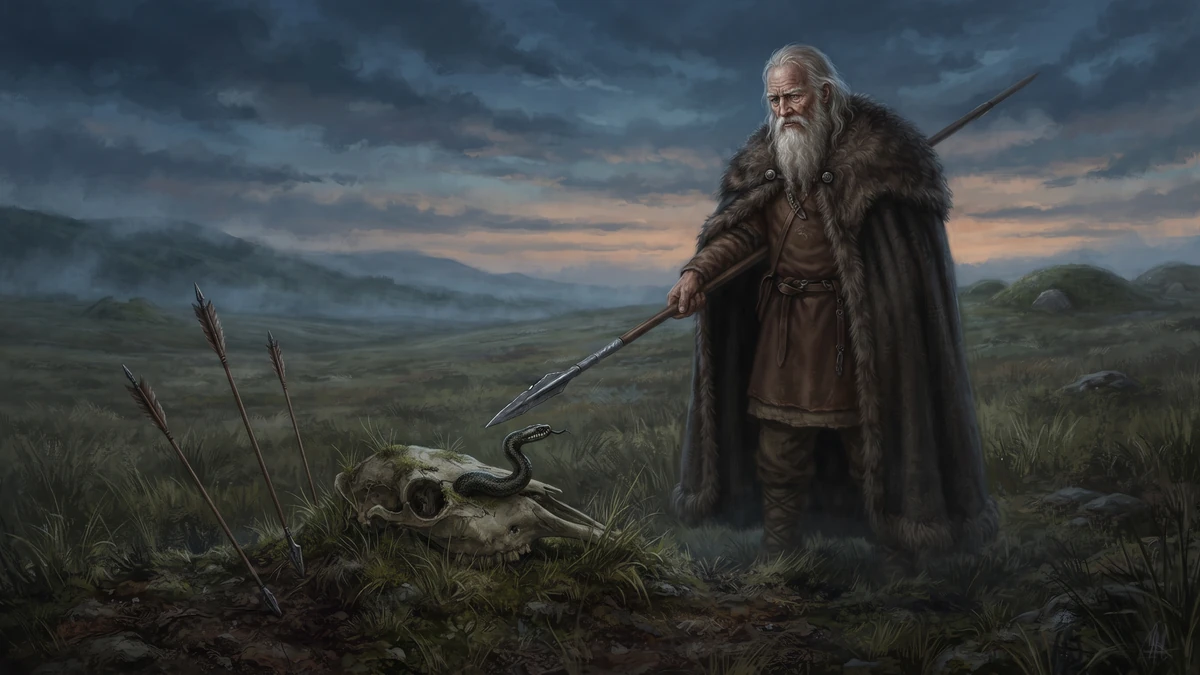
In medieval Norse literature, prophecies rarely fail. The Örvar-Odds saga, an Icelandic legendary saga of the 13th and 14th centuries, tells the life of a warrior who tried to disprove his own and who, according to the text, lived a great many years doing so.
The prophecy
Örvar-Oddr, “Arrow-Odd”, is the son of a Norwegian chieftain. According to the saga, in his youth he hears a seeress. She says he will live long, be famous in many lands and that, in spite of that, he will end by dying because of his horse, Faxi, which he considers the finest of all. Odd does not accept her word, and decides to stop it from coming true.
With his companion in arms, Ásmundr, he takes Faxi to a valley, kills the animal and digs a deep pit. The horse is buried, and the stones covering the pit are piled up into a mound. After that, Odd sets off over the sea.
The years of travel
The saga is an account of adventures. Odd reaches very distant lands, among them Bjarmaland, in the north, and Garðaríki, the land of the Rus. He fights giants, defeats warriors and wins a name as invincible. Among his weapons are three magic arrows, given to him by King Gusir and which, according to the text, always returned to the archer’s hand. Hence the nickname the saga gives him, “Arrow”.
Icelandic tradition credits him with a life of about three hundred years. That number, of course, belongs to legend, not to any historical record.
The return home
When he feels that much time has passed, Odd returns to Norway. He arrives in the region where he buried Faxi, and at Berurjóðr, the “bear meadow”, he finds the mound. Passing by it, he sees a horse’s skull half uncovered and pushes it with the tip of his spear. A viper comes out of the skull and bites him on the ankle.
Odd understands what has happened: it was Faxi’s skull. He composes some verses about what he saw and goes to his death with the prophecy fulfilled. The saga concludes that fate cannot be escaped, and that the very attempt to flee may lead to it.
The story circulated in other sources, and the Hervarar saga also mentions Odd. Scholars see in the Örvar-Odds saga a late work, mixing folkloric themes and travel tales about real and imaginary places.
The saga is classed as a fornaldarsaga, “saga of ancient times”, a group of Icelandic texts that mixes legendary heroes, monsters and journeys to distant lands. Unlike the sagas of the Icelanders, which are set in Iceland and have a more realistic tone, these works are set mostly in Scandinavia and in imaginary places, and their authors wanted less to record facts than to entertain and preserve old stories.
To add up Odd’s years, merging equal numbers until you reach the right total, play Odd’s years.
Sources.
- Unknown author, *Örvar-Odds saga* (Icelandic legendary saga, 13th and 14th centuries)
- Hermann Pálsson and Paul Edwards (trans.), *Arrow-Odd: A Medieval Novel* (New York University Press, 1970)
- Rudolf Simek and Hermann Pálsson, *Lexikon der altnordischen Literatur* (Kröner, 1987)