Thor and the giant Geirrøðr: the glowing iron, the iron gloves and the rising river
According to Snorri and the poem Þórsdrápa, Thor went to Geirrøðr's hall without hammer or belt, crossed a swelling river and caught a glowing bar with iron gloves. Here is the story.
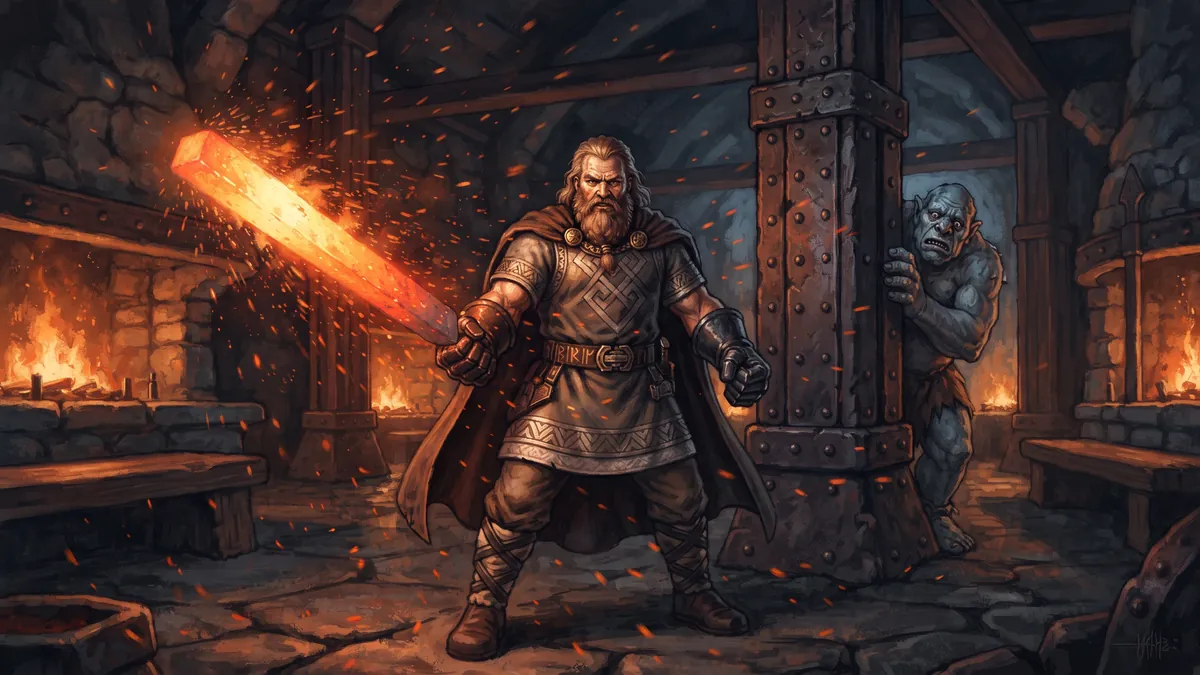
Among Thor’s adventures with giants, this is one of the tensest. He goes unarmed, crosses a river that seems to have a life of its own, and wins only because someone lends him what he lacks. The story has reached us in two forms: a poem of the 10th century and a prose account of the 13th.
A trap set by Loki
According to the Skáldskaparmál by Snorri Sturluson, the starting point was one of Loki’s pranks. He borrowed Frigg’s falcon cloak and flew to the house of the giant Geirrøðr. He landed on a window and was caught. The giant locked him in a chest for three months, until a starving Loki promised to bring Thor without the hammer Mjölnir and without his belt of strength.
Thor agreed to go, without seeing the plan, or at least without refusing it. On the way he stopped at the house of the giantess Gríðr, mother of Víðarr, who warned him of the danger. She lent him her belt of strength, a pair of iron gloves and a staff called Gríðarvölr.
The river Vimur and the giant’s house
To reach Geirrøðr, Thor had to cross the river Vimur. The water kept rising until it reached his shoulders. Thor looked upstream and saw Gjálp, a daughter of Geirrøðr, standing astride the banks and making the flood grow. He threw a stone at her and said that a river must be stopped at its mouth. Then he seized a rowan on the bank and climbed out. Hence the saying, recorded by Snorri, that the rowan is Thor’s salvation.
In the giant’s house, they gave him a seat. The chair began to rise toward the ceiling. Thor braced the staff against the rafters and pushed down. There was a crack and a scream: under the chair were Gjálp and Greip, Geirrøðr’s two daughters, and both had their backs broken.
The glowing iron
Geirrøðr then called Thor to a challenge. He took a glowing bar of iron from the fire with tongs and hurled it. Thor caught it in mid-air with the iron gloves. The giant ran and hid behind an iron pillar. Thor threw the bar back: it went through the pillar, the giant and the wall, and ended up on the ground outside.
Saxo Grammaticus tells, in book 8 of his Gesta Danorum, a similar story, with Thorkillus and a king called Geruthus. Specialists see a common tradition here, but cannot say which version is older in origin. The poem Þórsdrápa predates Snorri by two centuries, and Snorri quotes stanzas from it.
The episode shows a theme that recurs in several myths: Thor’s strength is not enough on its own. Here he survives thanks to objects lent by a giantess and to the branch of a tree, a reminder that even among the gods the help of others matters.
To try catching the glowing iron bars the giant hurls at Thor, play Geirrøðr’s bars.
Sources.
- Snorri Sturluson, *Prose Edda* (*Skáldskaparmál*, account of Thor at Geirrøðr's house, c. 1220)
- Eilífr Goðrúnarson, *Þórsdrápa* (late 10th-century poem, partly preserved in the *Skáldskaparmál*)
- Saxo Grammaticus, *Gesta Danorum* (book 8, c. 1200, episode of Thorkillus and Geruthus)