Odin and Vafþrúðnir: the wisdom contest where the head was the stake
In the poem Vafþrúðnismál, a disguised Odin challenges a giant famed for wisdom to a contest of questions, wagering his head. The last question, about Baldr, reveals who he is.
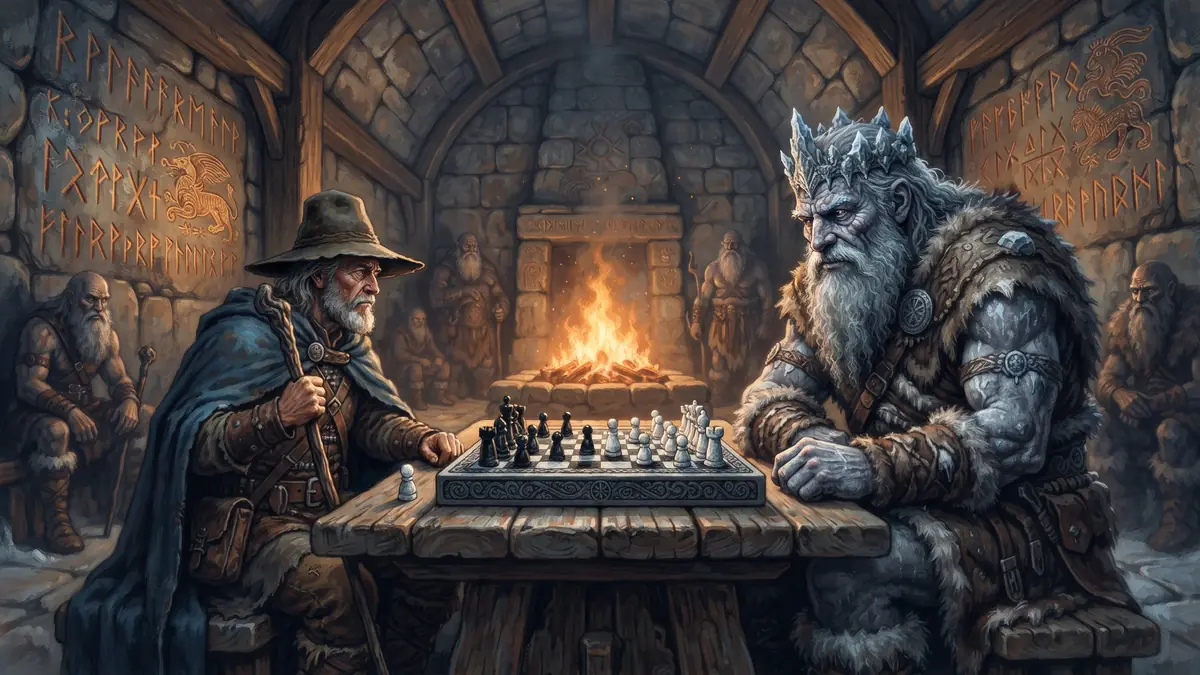
Odin is the god who seeks knowledge, and the Vafþrúðnismál, one of the poems of the Poetic Edda, shows him in a contest that could cost his life. There is no combat with weapons: the duel is of questions, and whoever fails loses his head.
The wager
The poem opens with Odin speaking to his wife, Frigg. He wants to visit the giant Vafþrúðnir, known for knowing everything about the worlds and the ages. Frigg tries to talk him out of it, because she judges that no giant compares with Vafþrúðnir in might. Odin goes anyway. Arriving at the giant’s hall, he introduces himself as Gagnráðr, “he who wins counsel”. The two agree on the wager: whoever cannot answer loses his head.
The giant begins. He asks the name of the horse that draws the day over the earth, and Odin answers Skinfaxi. He asks the name of the horse of night, and the answer is Hrímfaxi. He asks about the river that separates the gods from the giants, and Odin says it is the Ífing. He asks about the field where the gods and Surtr will meet: Vígríðr. The visitor gets everything right, and the giant invites him to sit.
Odin’s turn
Now Odin asks, and the questions are about origins. Where did the earth come from? From Ymir’s flesh, says the giant. Where did the sun and moon come from? Both are children of Mundilfari. What will remain after the end of the world, Ragnarök? Two humans, Líf and Lífþrasir, who will hide in Hoddmímir’s wood, and the sun will have a daughter as fair as herself. The giant answers everything firmly, and his wisdom seems complete.
The last question
Then Odin asks the question that only he can answer: what did Odin say into his son Baldr’s ear when they laid him on the pyre? Vafþrúðnir is silent for a moment. Then he says that no one knows what Odin whispered in the old days, and that he himself has gambled away the fate of his own life with his tongue. He acknowledges that the visitor is Odin and that the contest was lost from the start.
The poem ends there. It does not say what became of the wager, and many scholars assume the giant lost his head. Odin’s answer about Baldr was never recorded, and that is what makes the question work: only the one who asked it could give the answer.
The poem also helps us understand how the Norse organised knowledge. The questions about names of horses, rivers and fields, and about the origin of the world, work like a list of things a good poet was expected to master. Snorri quotes stanzas of the Vafþrúðnismál in several passages of the Gylfaginning, which shows that by the 13th century the poem was already treated as a store of mythological knowledge.
To face an opponent who knows every trick and prove who can count the stones better, play The duel of the stones.
Sources.
- Unknown author, *Poetic Edda* (*Vafþrúðnismál*, manuscript Codex Regius, c. 1270)
- Snorri Sturluson, *Prose Edda* (*Gylfaginning*, which quotes stanzas of the poem, c. 1220)
- Carolyne Larrington (trans.), *The Poetic Edda* (Oxford World's Classics, 1996)