The Three Billy Goats Bruse: the Norwegian tale of the bridge and the troll
Collected by Asbjørnsen and Moe in the 19th century, the tale of three goats crossing a bridge guarded by a troll is one of the best-known in Norwegian folklore.
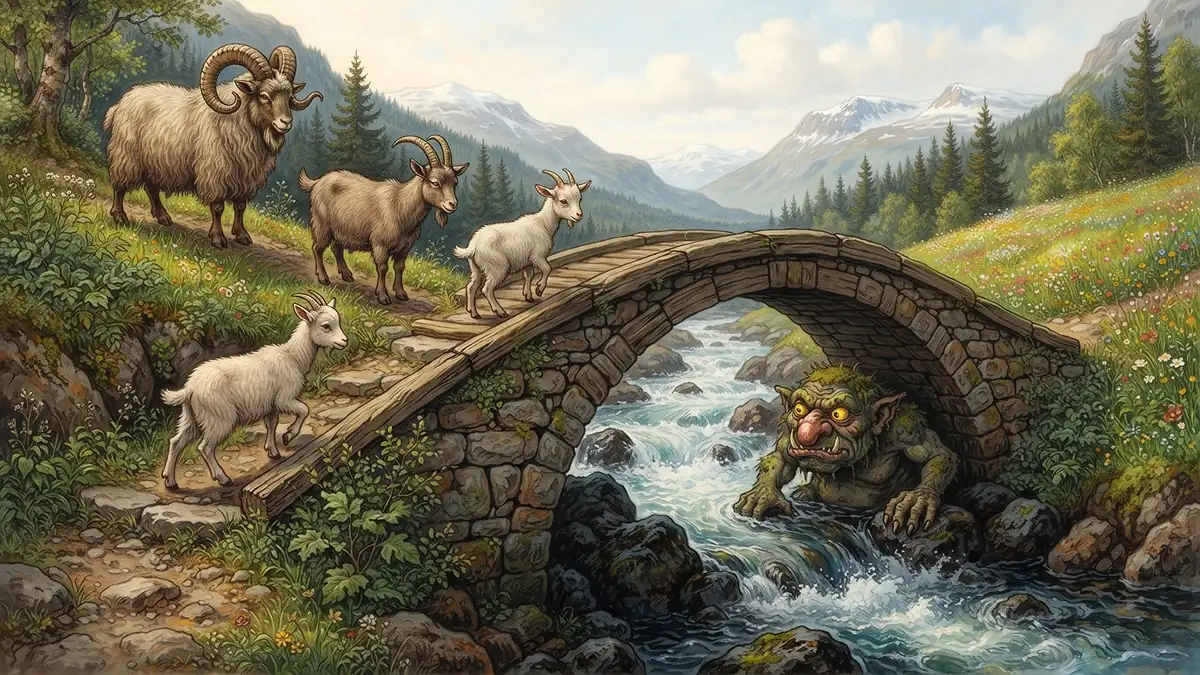
Once upon a time, in Norway, there were three brother billy goats, all named Bruse. In the spring, they wanted to climb the mountain to graze and grow fat. To get there, they had to cross a bridge, and under that bridge lived a troll with eyes as big as plates and a nose as long as a broomstick.
This version of the tale follows closely what Asbjørnsen and Moe recorded in the 19th century.
The first goat
The smallest was the first to cross. Trip, trap, trip, trap, went the bridge under his hooves.
“Who’s that walking on my bridge?” roared the troll.
“It’s me, the smallest of the Bruse goats. I’m going up the mountain to grow fat,” said the goat, in a thin voice.
“I’m going to gobble you up,” said the troll.
“Don’t do that,” begged the goat. “Wait for my middle brother. He’s much bigger than I am.”
“All right, go,” grunted the troll.
The second goat
Shortly after came the middle goat. Trip, trap, trip, trap, went the bridge, heavier now.
“Who’s that walking on my bridge?”
“It’s me, the middle one of the Bruse goats. I’m going up the mountain to grow fat.”
“I’m going to gobble you up!”
“Don’t do that. Wait for my older brother. He’s much bigger than I am.”
The troll grumbled and let him pass.
The big goat
Last came the biggest of the goats. Trip, trap, trip, trap, the bridge nearly broke under the weight.
“Who’s that walking on my bridge?” shouted the troll.
“It’s me, the great billy goat Bruse!”
“I’m going to gobble you up!”
But the big goat had two sharp horns and was not willing to wait. He answered that if the troll came up, he would poke out his eyes and crush him to bits. He threw himself at the troll, butted him and tossed him into the river, and there the monster disappeared.
The mountain
The three goats went on to the pasture. The grass was so good that they grew fat, and so fat that they could hardly walk home. If their fat has not gone, says the end of the tale, they are still there.
In Norwegian folk tales it is common to end with a short verse that announces the story is over. Here, the original ends in rhyme: Snipp, snapp, snute, så er eventyret ute, something like “snip, snap, snout, this tale’s told out”.
The tale and its time
Asbjørnsen and Moe, two friends, spent years listening to and writing down stories told in the countryside, and published them from 1841. They played an important part in building a Norwegian cultural identity in the 19th century, when the country was seeking to assert its language and tradition after centuries of union with Denmark.
Trolls, creatures of the mountains and forests, are a constant presence in Scandinavian folklore. The tale of the Bruse goats is today one of the best known in Norwegian folklore.
To cross the bridge yourself, play The Three Billy Goats Bruse.
Sources.
- Peter Christen Asbjørnsen and Jørgen Moe, *Norske Folkeeventyr* (Norwegian Folk Tales), published from 1841