Baldr, the god nothing could harm, and the sprig of mistletoe nobody remembered to protect
Baldr's mother made every thing swear not to hurt him. She left out one small sprout, and it was with that sprout that the god died.
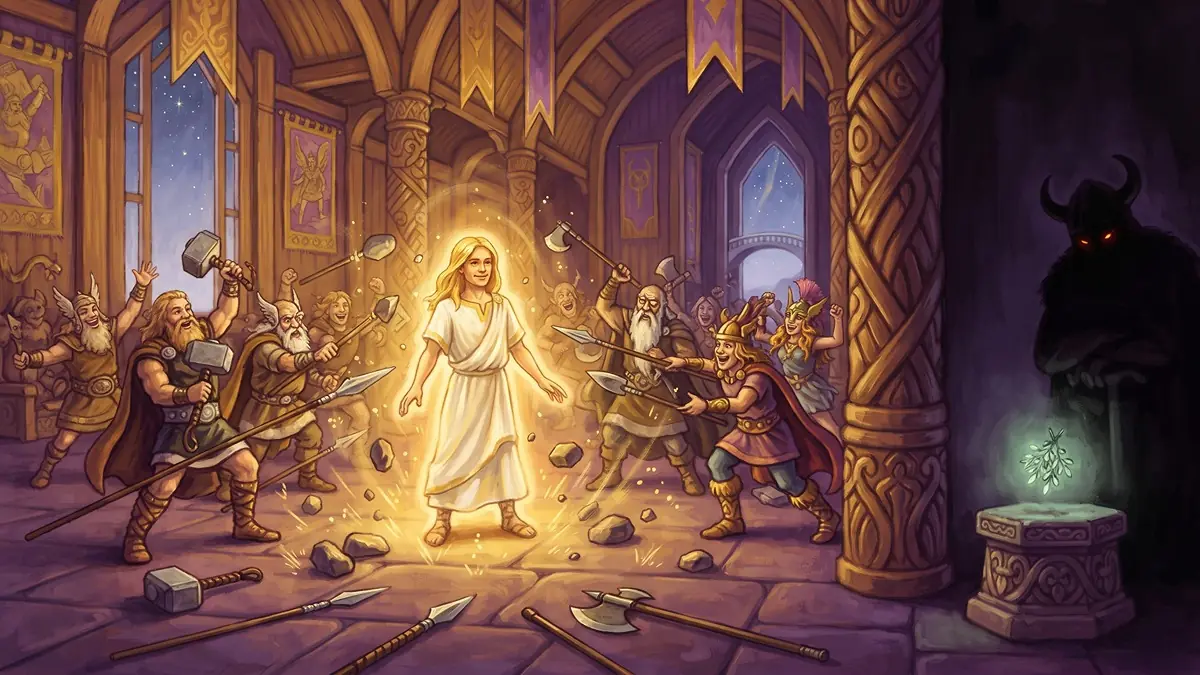
Among the gods of Asgard, Baldr was the best loved. Son of Odin and Frigg, handsome and just, he shone so much that a white flower was compared to his face. The story of his death is one of the best known in Norse mythology, and it was preserved mainly by Snorri Sturluson in the 13th century.
The dream and the oaths
Baldr began having dreams that foretold his death. The gods gathered, and Frigg decided to act. She travelled the world and took oaths from all things: fire, water, iron and the other metals, stones, earth, trees, diseases, animals, birds and snakes. All promised not to harm Baldr.
With the guarantee made, the gods began to amuse themselves. Baldr stood in the middle of the circle, and the others shot at him, struck him, or threw stones. Nothing hurt him, and everyone thought it a great honour.
The sprout that looked too young
Loki, the trickster god, did not like the game. Disguised as a woman, he went to Frigg and asked whether all things had really sworn. She answered that nearly all had. West of Valhalla grew a sprout of mistletoe that had seemed too young to ask for an oath.
Loki pulled up the mistletoe, went to the circle of the gods and found Höðr, the blind god, standing at the edge. He asked why Höðr was not throwing anything at Baldr. Höðr answered that he could not see where his brother stood and had nothing to throw. Loki handed him the mistletoe and guided his hand. The sprout went through Baldr’s body, and he fell dead.
The gods in silence
According to Snorri, the gods were struck speechless, and none of them could take revenge in that place, because it was sacred ground of peace. Baldr’s wife, Nanna, died of grief. The god’s body was laid on a ship, the Hringhorni, and burned on a pyre.
Hermóðr, another son of Odin, rode nine nights on the horse Sleipnir to the realm of Hel to ask for Baldr’s return. Hel answered that he could come back if all things in the world wept for him. All wept, except one giantess named Þökk. Snorri says the giantess was Loki in disguise. Baldr stayed where he was, until the end of the world.
What the sources say
The poem Völuspá sums up the episode in a few stanzas and adds that Váli, a son of Odin, was born to avenge Baldr and kill Höðr. The version by the Danish historian Saxo Grammaticus is quite different: in it, Höðr is a human rival of Baldr, and it is Baldr who dies in battle.
The Christmas custom of kissing under mistletoe is much later and does not come from this story. The link between the two is a modern association, with no Old Norse source.
What the myth leaves behind is a curious warning: Frigg’s power was enormous, but one small exception was enough to bring it down.
To play with Frigg’s oaths, open Frigg’s oaths.
Sources.
- Snorri Sturluson, *Prose Edda*, section Gylfaginning (c. 1220)
- *Völuspá*, poem of the *Poetic Edda* (13th-century manuscripts)
- Saxo Grammaticus, *Gesta Danorum*, book III (c. 1200), a different Danish version