How Loki tricked the builder of Asgard's wall and gave birth to the horse Sleipnir
A builder and his horse nearly finished the gods' wall in a single winter. Loki, turned into a mare, delayed the work, and from that came Odin's horse.
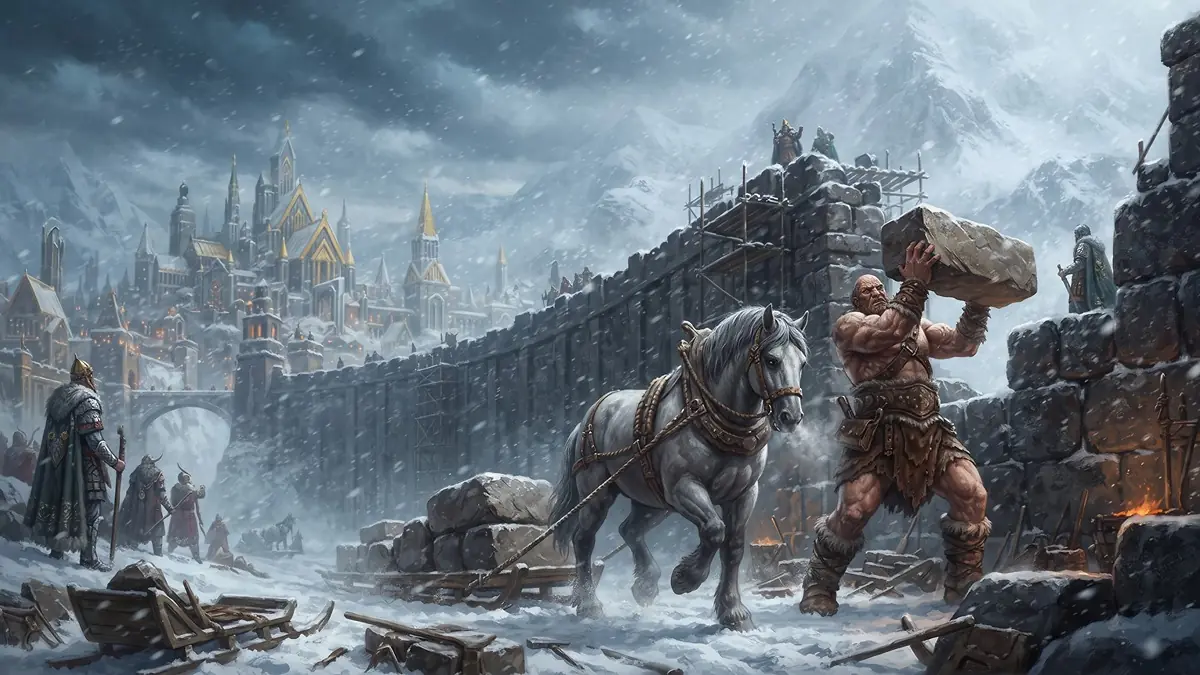
Few Norse myths mix labor, trickery and humor as much as the story of the wall of Asgard. It is a short account, preserved by Snorri Sturluson in the Prose Edda, and it ends with the birth of the eight-legged horse that would carry Odin.
The builder’s offer
According to Snorri, the gods did not yet have a fortress safe from giants when a builder appeared and promised to raise one, strong and tall, in three seasons. In return he wanted Freyja as his wife, along with the Sun and the Moon.
The gods debated and, on Loki’s advice, agreed on one condition: the work had to be finished in a single winter, with no one’s help. If on the first day of summer any part was missing, the builder would get nothing. He asked only for the help of his horse, Svaðilfari, and the gods agreed.
The horse that hauled rocks
The horse did twice the work of its master and dragged enormous blocks of stone. Near the end of winter, the wall was almost done and only a few days remained before summer. The gods realized they would lose Freyja, the Sun and the Moon, and blamed Loki for the advice. They threatened him with death if he did not find a way to stop the work.
Loki becomes a mare
That night, when the builder went out with the horse to fetch stones, a mare ran out of the forest and neighed at Svaðilfari. It was Loki in disguise. The horse broke its harness and ran after her, and the builder chased the two of them all night. The work did not advance, and the deadline passed without the wall being finished.
Seeing he had been tricked, the builder revealed himself to be a giant and flew into a rage. Thor was called and killed the giant with his hammer.
Loki’s child
Some time later, Loki returned with a grey foal with eight legs, the best horse among gods and men: Sleipnir, whom Odin came to ride. The myth makes Loki both the father and the mother of the animal.
How to read the myth
Snorri wrote centuries after Iceland’s conversion to Christianity, and the episode has come down in one long version. The poem Völuspá, in the Poetic Edda, alludes to oaths made to a giant and broken by the gods, which some scholars connect to this story, but the poem does not tell the episode in full.
To delay the wall like Loki, play The wall of Asgard.
Sources.
- Snorri Sturluson, *Prose Edda*, Gylfaginning, chapter 42 (c. 1220)
- *Poetic Edda*, poem Völuspá (13th-century manuscript)