Eirik the Red: the outlaw who gave Greenland the name of a good land
Banished from Norway and then from Iceland, Eirik explored an unknown coast and called it Greenland to attract settlers. The sagas say 25 ships set out and 14 arrived.
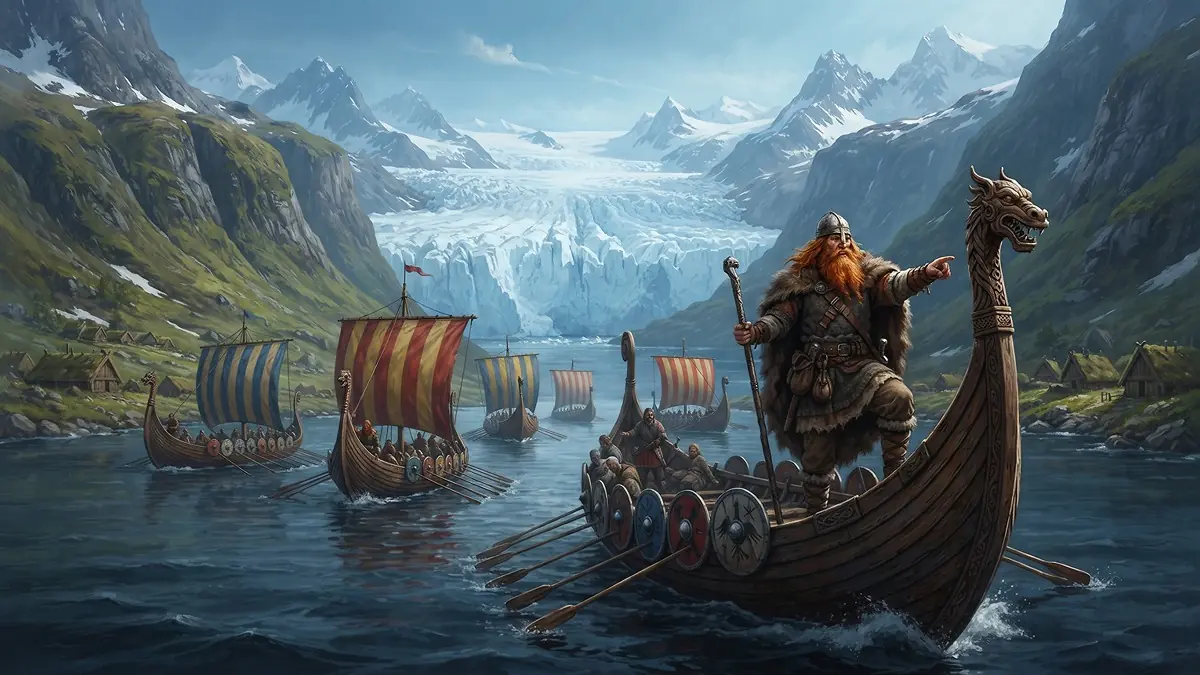
Greenland is almost entirely covered in ice, yet it bears the name “green land”. According to the Icelandic sagas, the choice was made by the man who settled it, Eirik Thorvaldsson, known as Eirik the Red. His story appears in two sagas and in the Landnámabók, written in Iceland more than two centuries after the events, and it holds some points that historians accept and others that remain saga narrative.
The banished man
According to the Eiríks saga rauða, Eirik’s father, Thorvald, was forced to leave Norway because of killings he had caused, and went with his family to the northwest of Iceland. There, Eirik married and set up a farm. After a quarrel over dead neighbours, he was banished from the district. He moved to islands off the coast, quarrelled again, this time over borrowed wooden beams that were not returned, and ended up killing the sons of a man called Thorgest.
For that, the Icelandic assembly sentenced him to exile for three years, around 982. Under Icelandic law, the convicted man had to leave the country for that time, and if he stayed he lost legal protection.
The unknown land
Eirik prepared a ship and went in the direction in which, according to the saga, another navigator had sighted a land to the west. He found a mountainous coast and spent his exile exploring it, naming places and choosing where to settle. Among the southern fjords he found pastures and land where cattle could be raised.
When he returned to Iceland, the saga says the name was chosen on purpose: Eirik called the land Greenland because, he said, people would go there more eagerly if the land had a good name. Some see in this an ancient piece of advertising. Others point out that the southern fjords really do turn green in summer.
Twenty-five ships
In 985 or 986, Eirik sailed from Iceland with a fleet of settlers. The saga says 25 ships set out, and 14 arrived. Some turned back, and others were lost at sea. The fleet settled in the southern fjords, in what came to be called the Eastern Settlement, and Eirik founded the farm of Brattahlíð, today identified with Qassiarsuk, in southern Greenland.
The Norse colony lasted about four centuries. It grew to between 2,000 and 3,000 people, with farms, churches and a trade in walrus ivory with Europe, and it lost contact with Scandinavia in the middle of the 15th century. Why it ended is still discussed among archaeologists, and the explanations range from a colder climate to the fall of trade.
The children
Eirik had children who entered the sagas in their own right. The most famous, Leif, was the one who, according to the Grænlendinga saga, reached Vinland. The saga says that Eirik, by then old, refused to convert to the Christianity his son brought and stayed faithful to the old religion.
To steer a fleet to Greenland, play Twenty-five ships.
Sources.
- *Eiríks saga rauða* (13th century)
- *Grænlendinga saga* (13th century)
- *Landnámabók*, the Book of Settlements (12th century, 13th-century versions)