The Birka warrior: the grave excavated in 1878 and the debate DNA reopened in 2017
For over a century, grave Bj 581 was taken as that of a warrior chieftain. In 2017, DNA showed the skeleton was a woman's, and archaeologists are debating what that means.
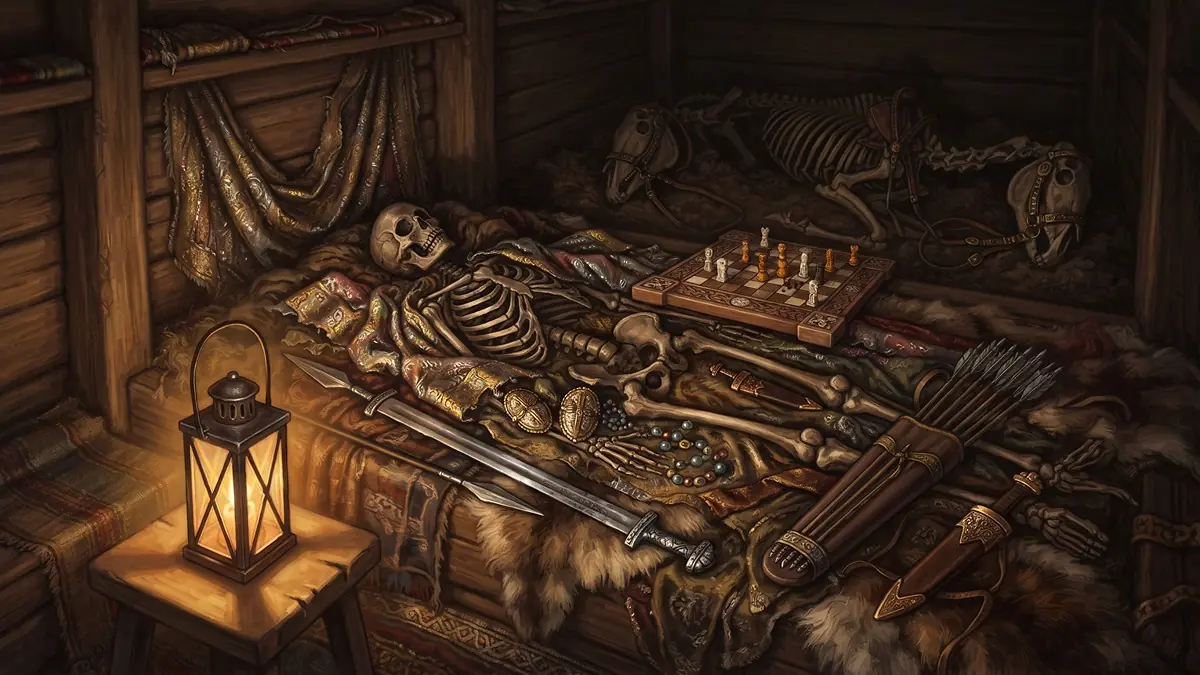
In 1878, the Swedish archaeologist Hjalmar Stolpe excavated, on the island of Björkö, where the Viking town of Birka stood on Lake Mälaren, a wooden burial chamber with weapons and two horses. For him, and for more than a century, it was obvious that the person buried was a warrior chieftain. In 2017, a DNA study concluded that the remains were a woman’s. Since then, archaeologists have debated what that means.
What was in the grave
The grave, numbered Bj 581, measures about 3.45 by 1.75 metres and was marked by a large boulder, on a terrace beside the town’s garrison. From the date of an Arabic silver coin found there, the burial belongs to the first half of the 10th century, perhaps around 940.
There was a sword in its scabbard, an axe, a fighting knife, two spearheads, 25 arrowheads and two shield bosses. There was also a mare and a stallion with bridles, and stirrups attached to the dead person’s feet. Among the objects were remains of silk with silver embroidery and a hat with tassels. And a set of 28 gaming pieces, with a king, three dice and an iron frame for the board. Many see in this set a sign of military strategy, possibly of the game hnefatafl.
The skeleton
Since Stolpe, the occupant was taken to be a man. Analyses of the bones had already indicated a woman, in the 1970s and again in 2016, by the anthropologist Anna Kjellström, but the conclusions were dismissed. In 2017, a team led by Charlotte Hedenstierna-Jonson, of Uppsala University, sequenced the DNA and found two X chromosomes and no Y. The person was over 30. Isotope analyses indicated that she had moved from another region, possibly from southern Sweden or Denmark.
The team concluded that this was a woman of high military rank, and used the term “high-ranking female warrior”. It argued that the weapons seemed to have been used and not merely symbolic, and that there were no objects typical of women’s graves. Hedenstierna-Jonson said the identification as a man lasted so long partly because of the assumptions of those who excavated.
The debate
The conclusion was challenged by other specialists. The Swedish archaeologist Anne-Sofie Gräslund had already remarked in 1980 that “warrior grave” does not necessarily mean someone who fought, because weapons can indicate social position. Fedir Androshchuk, in 2018, pointed out that the Birka graves had been disturbed and that Stolpe had relied on untrained helpers. Judith Jesch criticised the use of written sources and the lack of other explanations, and Martin Rundkvist noted that grave goods do not reveal the sex of the buried person.
In 2019, Neil Price and colleagues replied in the journal Antiquity, maintaining the conclusion. The discussion continues: what seems beyond doubt is that the remains are a woman’s, and what is debated is the role she had in life.
What the grave shows
The sagas and poems speak of women warriors, the skjaldmeyjar, “shield-maidens”, but few scholars take them as fact. Bj 581 is the burial that comes closest to proving that a woman, in the Viking Age, could be buried with all the symbols of a war chief. Even those who see her as a military leader admit that a single grave does not allow us to speak of many women like her.
To choose what belonged in the grave, play The grave goods.
Sources.
- Charlotte Hedenstierna-Jonson and others, 'A female Viking warrior confirmed by genomics', *American Journal of Physical Anthropology*, 2017
- Neil Price and others, 'Viking warrior women? Reassessing Birka chamber grave Bj.581', *Antiquity*, 2019
- Anne-Sofie Gräslund, *Birka IV: The Burial Customs*, 1980