The Nøkken: the lake spirit who plays the fiddle and drowns those who come near
In Scandinavian folklore, the nøkken lives in lakes and rivers and changes shape to lure victims. The stories, collected mostly in the 18th and 19th centuries, show how people explained the dangers of water.
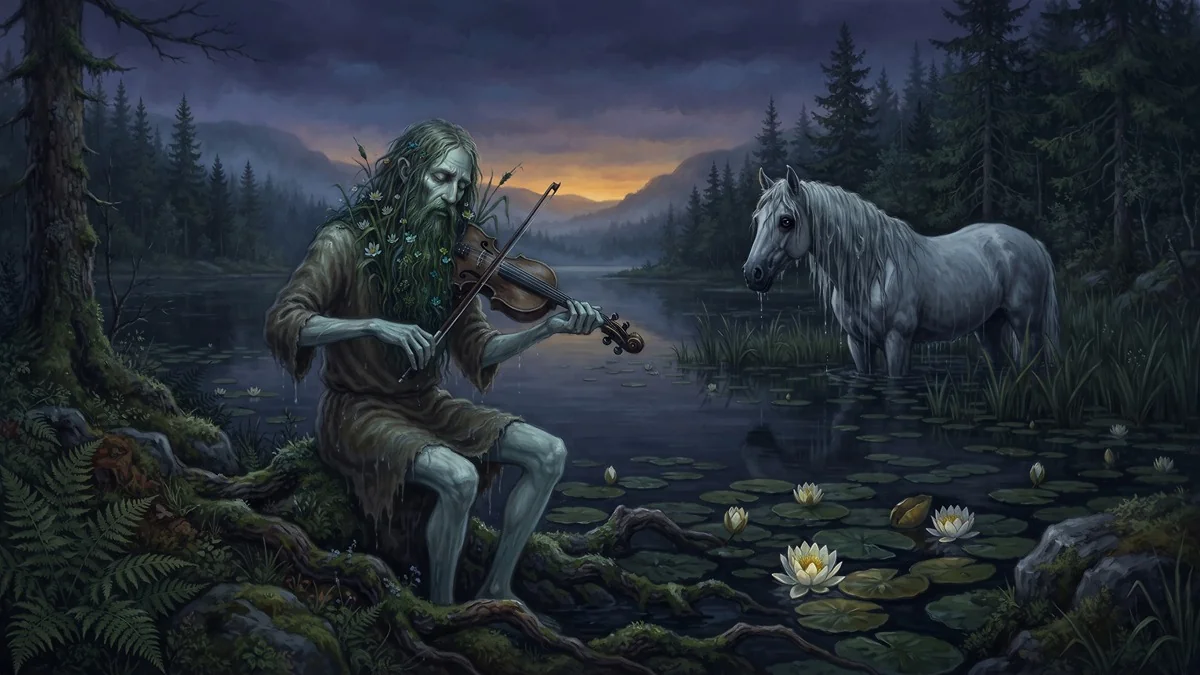
Anyone who lives near dark lakes knows that water can be treacherous. In Norwegian folklore, the danger had a face: the nøkken, a being that lives in lakes, rivers and tarns, the small mountain pools, and lures people into the water. The name appears in Sweden as näcken and in Denmark as nøkken, and is a relative of the English “nix”.
Many shapes, one trick
The nøkken changes shape. In the stories, it appears as a white or grey horse, beautiful and tame, standing on the shore. Whoever climbs on its back cannot get off again, and the animal dives. It also appears as an ordinary-looking man, sometimes in wet clothes, or as an old man. In some versions it is a fiddler so good that people dance without stopping, beside the water, until they fall into it.
In many accounts, the nøkken is seen as an explanation for drownings, especially of children. Telling them that a spirit waited in the water was a way of keeping the little ones away from the bank.
How to protect yourself
Traditions vary a good deal from one region to another, but some ideas repeat. Iron and steel drive the being away, which is why a knife or a needle appear in tales of defence. So does the sign of the cross. And knowing the name of such a creature gave power over it, a belief common in European folklore: in some tales, calling the nøkken by its name sends it running. That is the idea the game borrows.
An image that stuck
The Norwegian painter Theodor Kittelsen, known for his illustrations of trolls, drew and painted the nøkken in the early 20th century, among water lilies, in a silent and unsettling setting. His images helped fix the creature’s look in the country’s visual memory.
Today the nøkken frightens no one any more, but it lives on in children’s books, in music and in games. The lake is the same.
The nøkken has relatives elsewhere. The Swedish näcken also plays the fiddle and draws in whoever listens. In Norway there is also the fossegrim, the spirit of waterfalls, who according to tradition teaches the fiddle to anyone who offers him food, such as meat or a goat. In both cases, the music is bait and gift at once.
These stories passed from mouth to mouth, and each region had its own version, with its own details about the creature’s looks and habits.
To try to drive it off, play The Nøkken’s name.
Sources.
- Collections of Norwegian and Swedish folklore from the 19th and 20th centuries on the nøkken and the näcken
- Theodor Kittelsen, paintings and drawings of the nøkken, early 20th century
- Entries in Nordic encyclopedias on water beings in folklore