Althing, 930: the open-air parliament of Þingvellir and the man who recited the laws by heart
Around 930, Icelanders gathered in a lava valley to create an assembly without a king. The Althing is named the oldest legislature in the world and has survived, with interruptions, to this day.
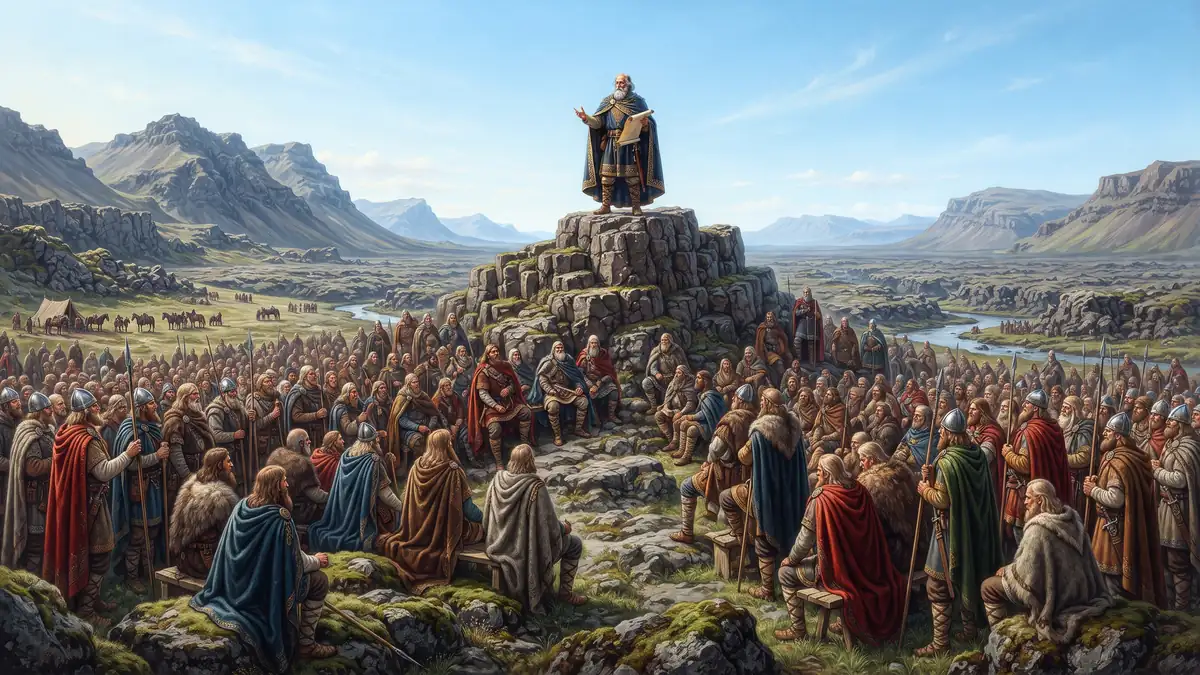
In medieval Iceland there was no king. There were chieftains, and among them a place was needed to settle disputes. The solution was the Althing, a general assembly that, around the year 930, began to meet at Þingvellir, about 45 kilometres east of where Reykjavík stands today. It is named the oldest surviving legislature in the world, and 930 is the date most cited for its founding.
The place
Þingvellir is an open valley in a lava rift, where the tectonic plates of North America and Eurasia pull apart. It was a place of reasonable access and with enough space for many people to camp. Once a year, in summer, chieftains and their men came from all over the island to the assembly.
The lawspeaker
Authority lay with the lögsögumaður, the lawspeaker. Standing on the Law Rock, the Lögberg, he recited the laws by heart, so that all could hear them. As there were no written laws, one person’s memory was the code itself. According to what is usually said, the office was held for a limited period and in parts, but these details vary by source.
The first law of Iceland is said to have come from a man called Úlfljótr, who spent three years in Norway studying the laws there and brought back an adapted version. This is associated with the Gulathing law.
A decision with weight
The most famous decision of the Althing is the adoption of Christianity in the year 1000. According to Njáls saga, the assembly was divided between pagans and Christians and threatened to split in two, until Þorgeirr, the goði of Ljósavatn, spent a day and a night in silence under a cloak and announced that the country should have one law and one religion. Historians remind us that the saga was written later and that the account has literary features.
End and return
The Althing lost power little by little, under Norwegian and then Danish rule, and was abolished by royal decree in 1800. A new Althing was created by decree on 8 March 1843, elections were held in 1844 and the new assembly first met on 1 July 1845.
A symbol
For Icelanders, Þingvellir is a place of identity. It is a World Heritage site and a national park, and its value lies less in ruins than in what it represents: the idea that a people’s laws can be made by the people themselves, aloud, in the open air.
To recite the law at the right rhythm, play The Lawspeaker.
Sources.
- Encyclopedia entries and the Þingvellir national park on the Althing
- Íslendingabók and Njáls saga, on the law and the adoption of Christianity
- Historical records of the Icelandic parliament