Maldon, 991: the battle that led the English to pay tribute to the Vikings
On a causeway flooded by the tide, three Englishmen held a Viking army. The English leader then let the enemy cross, lost the battle and England began to pay the Danegeld.
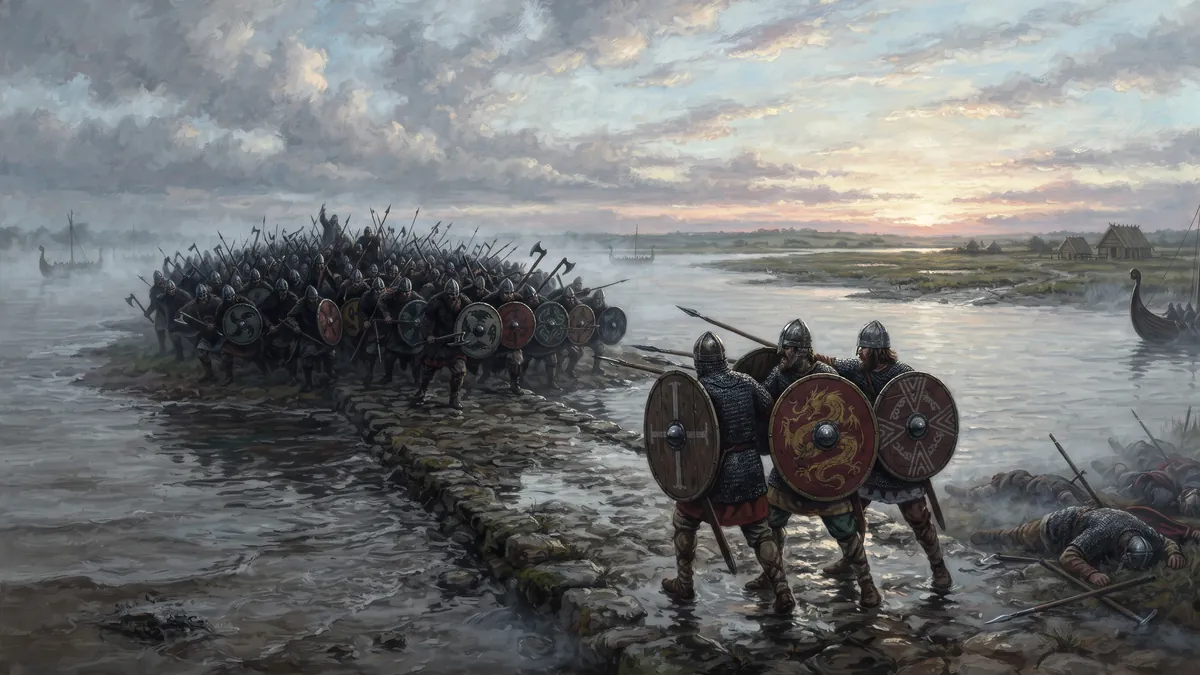
In August 991, near Maldon in the county of Essex, England, a Viking force landed and was met by English troops under the command of Ealdorman Byrhtnoth. The battle was an English defeat, and what came next made it famous: King Æthelred began to buy peace.
The date and the army
The battle is dated to 10 or 11 August 991. The versions of the Anglo-Saxon Chronicle differ: the one from Ely gives the 10th, those from Winchester and Ramsey the 11th. The Winchester one places it, by error, in 993. The Viking army is estimated at two to four thousand men, led by a chief called Olaf, possibly Olaf Tryggvason, the future king of Norway.
The causeway
The Vikings occupied an island joined to the shore by a causeway that the tide covered and uncovered, and by the poem’s description it matches Northey Island. While the tide was high, no one crossed. Three English warriors held the causeway and kept the enemies from crossing it.
Byrhtnoth’s pride
The poem says that, seeing the crossing blocked, the Vikings asked to cross and fight on open ground. Byrhtnoth agreed and let them pass. The poem calls this ofermōd, a word that can mean excessive pride, and the author seems to hint that it was a mistake.
In the fight that followed, Byrhtnoth was killed. The body, according to tradition, was found headless with its gold-hilted sword. One of his men, Godrīc, fled mounted on Byrhtnoth’s horse, which made others believe the chief was still alive and desert. Those who stayed swore to die beside their lord, and the poem records their speeches.
The Danegeld
After the defeat, Archbishop Sigeric advised the king to pay. The sum was ten thousand pounds of silver, the first Danegeld, the tribute paid to the Danes so that they would leave. The king paid other times, and the practice stood as an example of a policy that does not solve the problem.
The poem
The Battle of Maldon is a poem of 325 lines in Old English, but it is a fragment, with no beginning or end. The manuscript was lost in the fire of the Cotton library in 1731, and the text survives because it was transcribed in 1724. Scholars debate how faithful it is to the facts.
To defend the causeway against the tide and the invaders, play The Maldon causeway.
Sources.
- The Battle of Maldon, Old English poem (325-line fragment)
- Anglo-Saxon Chronicle (Ely, Winchester and Ramsey versions)
- Encyclopedia entries on the battle of Maldon and the Danegeld