Mímir and the well of wisdom: the eye Odin gave and the head that kept speaking
In the Norse sources, Odin gives an eye to drink from Mímir's well, and Mímir himself, beheaded by the Vanir, goes on advising the god. Two stories from different texts form the picture.
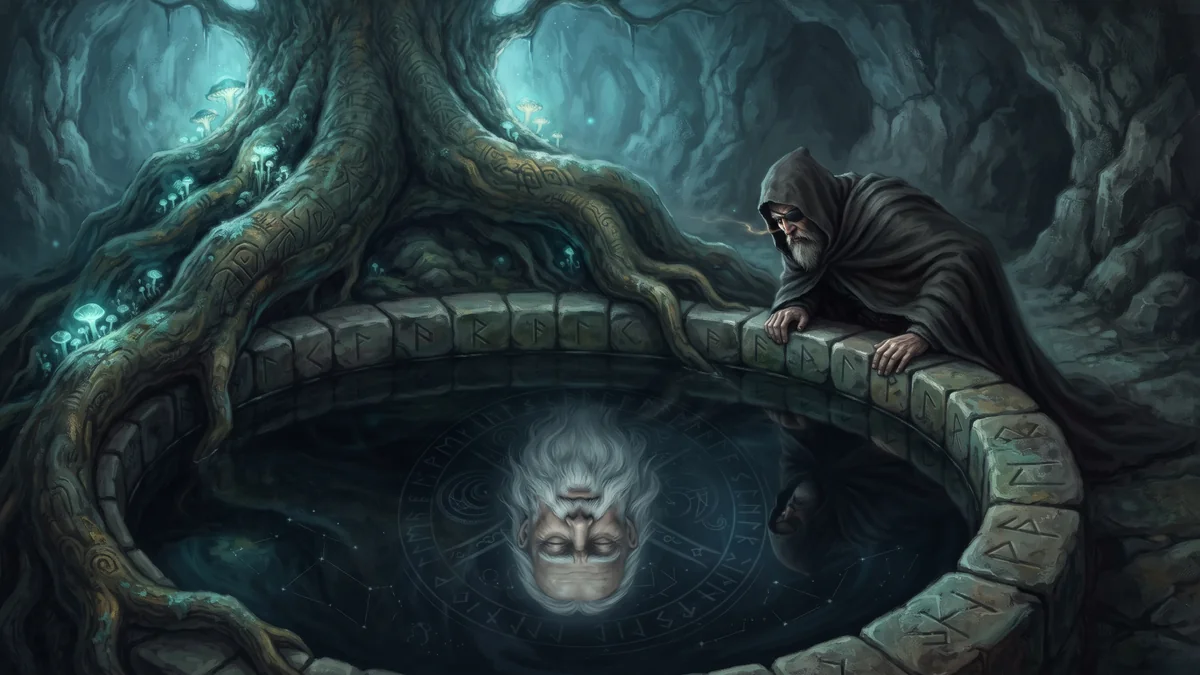
Odin, the god who sought knowledge, paid for it with part of his own body. In one poem, he leaves an eye in Mímir’s well. In another text, the owner of the well loses his head and it goes on advising the god. The two stories come from different sources, and it is necessary to keep them apart.
The well under the root
In the Gylfaginning, the part of the Prose Edda in which Snorri Sturluson summarises the myths, Mímir’s well lies under one of the three roots of Yggdrasil, the world tree, in the territory of the frost giants. Mímir drinks from it every day, and the water gives him great knowledge. The Völuspá, the poem that opens the Poetic Edda, says that Odin left his own eye in the well, as a pledge, and that Mímir drinks mead every morning from that pledge.
The head that speaks
The other story appears in the Ynglinga saga, in Snorri’s Heimskringla, which tells the myths as if they were the first kings. After a war between the two groups of gods, the Æsir and the Vanir, the sides exchange hostages to seal the peace. The Æsir send Mímir to Vanaheim, in return for Kvasir, and Hœnir becomes chief among the Vanir. Hœnir could only decide with Mímir’s counsel and, when he was absent, answered: “Let others decide.”
The Vanir felt cheated and cut off Mímir’s head, which they sent to the Æsir. Odin preserved it with herbs and spoke charms over it, so that it could speak and reveal secrets. The saga says he took to carrying it with him and consulting it about things from other worlds.
What the poems add
In the Völuspá, Mímir’s head still advises Odin as Ragnarök approaches. The Gylfaginning says that Odin rides to Mímir’s well, at that hour, to ask for counsel. The Sigrdrífumál, another poem of the Edda, mentions a speaking head. These references are short, and scholars read them with caution, because each text was written at a different time and place.
There is also a hypothesis about the Hávamál. In it, Odin says he learned nine magic songs from the brother of his mother Bestla, without giving the name. Some scholars think this uncle is Mímir. It is only a hypothesis, and it is not confirmed by the text.
The name
Philologists usually link the name Mímir to an Indo-European root meaning “to think, to remember”. Simek translates the name as “the rememberer”. The name fits the role: Mímir is the memory of the world, kept in a spring and in a head.
To answer the questions Odin would ask, play Mímir’s well.
Sources.
- Völuspá, stanzas 28 and 46 (Poetic Edda)
- Gylfaginning, chapters 15 and 51 (Prose Edda, by Snorri Sturluson)
- Ynglinga saga, chapters 4 and 7 (Heimskringla)
- Sigrdrífumál, stanza 14 (Poetic Edda)