Trelleborg: the circular fortress the Vikings built with perfect geometry
A ring of earth and timber with four gates, sixteen longhouses and a cemetery of young men. The fortress of Trelleborg, in Denmark, was raised in 981 and used for only a few years.
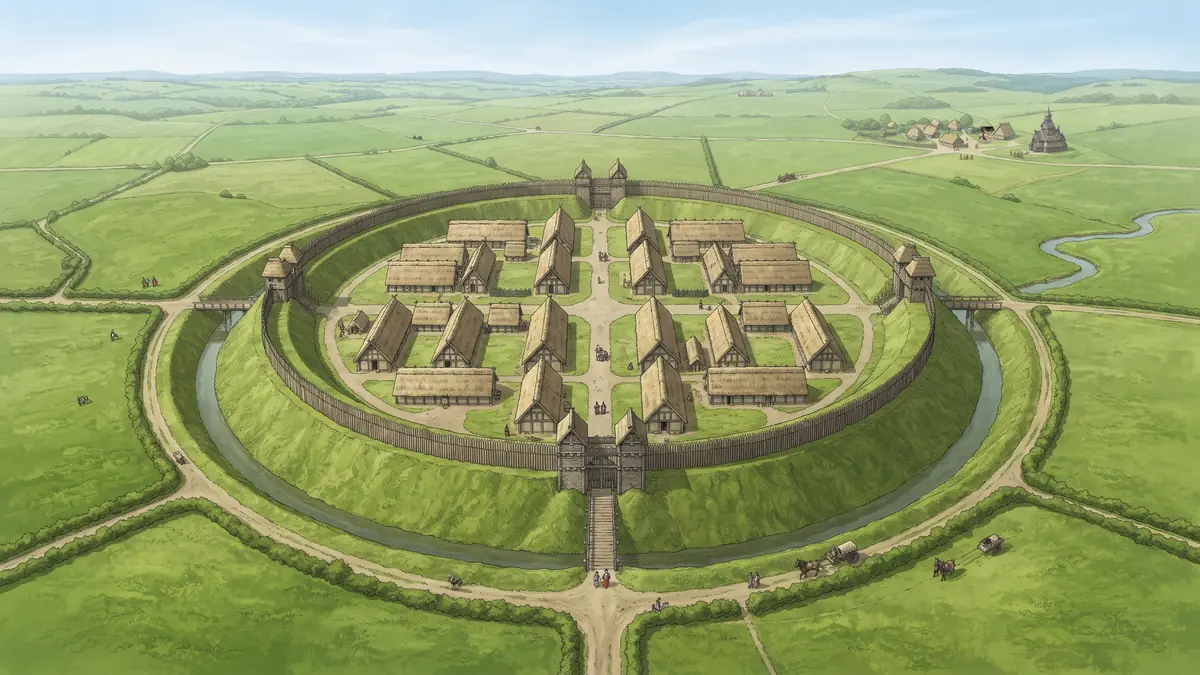
Anyone who sees Trelleborg from above understands at once that there was a plan. The fortress, near Slagelse, on the island of Zealand in Denmark, is an almost perfect ring of earth, with four gates in a cross and longhouses lined up in squares. It is one of the most orderly constructions of the Viking Age.
When it was built
Tree-ring dating, dendrochronology, shows that the timber was felled in the autumn of 980 and that the fortress was raised in the spring of 981. This corrects an old date that put it around the year 1000. The work is attributed, as probable, to King Harald Bluetooth, the same one associated with the Christianisation of Denmark.
The design
The ring measures about 136 to 137 metres in diameter. The earth rampart was some five metres high and almost eighteen wide. Four gates opened at the cardinal points, linked by two streets that crossed at the centre and divided the interior into four quarters. In each quarter there were four longhouses set in a square, making sixteen in all. Outside the ring, there was an outer yard with fourteen or fifteen more houses.
The geometry was so exact that archaeologists could estimate the units of measure used in the work.
The cemetery
Near the fortress there was a cemetery with about 135 graves, mostly of young men, three of them mass graves. This indicates that the fortress housed mainly men, which fits the idea of a military post and not a village of families.
How long it lasted
The fortress was used for a short time, probably ten to fifteen years, according to some sources. Others estimate it was no more than twenty to thirty. Afterwards, it was abandoned.
What it was for
Trelleborg is not the only one. Similar fortresses have been found at Fyrkat, Aggersborg and Nonnebakken in Denmark, and there is one at Trelleborg in the region of Scania, now Sweden. What they were for is debated. Some see in them centres of royal administration and tax collection, some see military posts to control the territory, and some see starting bases for expeditions. Scholars have no consensus, and each hypothesis has its arguments.
What remains
Today the ring of Trelleborg is a visitor site, with reconstructed houses, and the original layout is still visible on the ground. For many people, the fortress is the image of a kind of state the Vikings knew how to build: planned, measured and made to last longer than it did.
To raise the fortress yourself, play Build Trelleborg.
Sources.
- National Museum of Denmark, excavations and tree-ring dating at Trelleborg
- Encyclopedia entries on the Viking ring fortresses
- Archaeological publications on Trelleborg, Fyrkat, Aggersborg and Nonnebakken