Alfred the Great, the king who lost everything and won at Edington — and the burnt cakes
In 878 the king of Wessex fled to the Somerset marshes, gathered an army and defeated the Vikings at Edington. The story of the burnt cakes is a late legend.
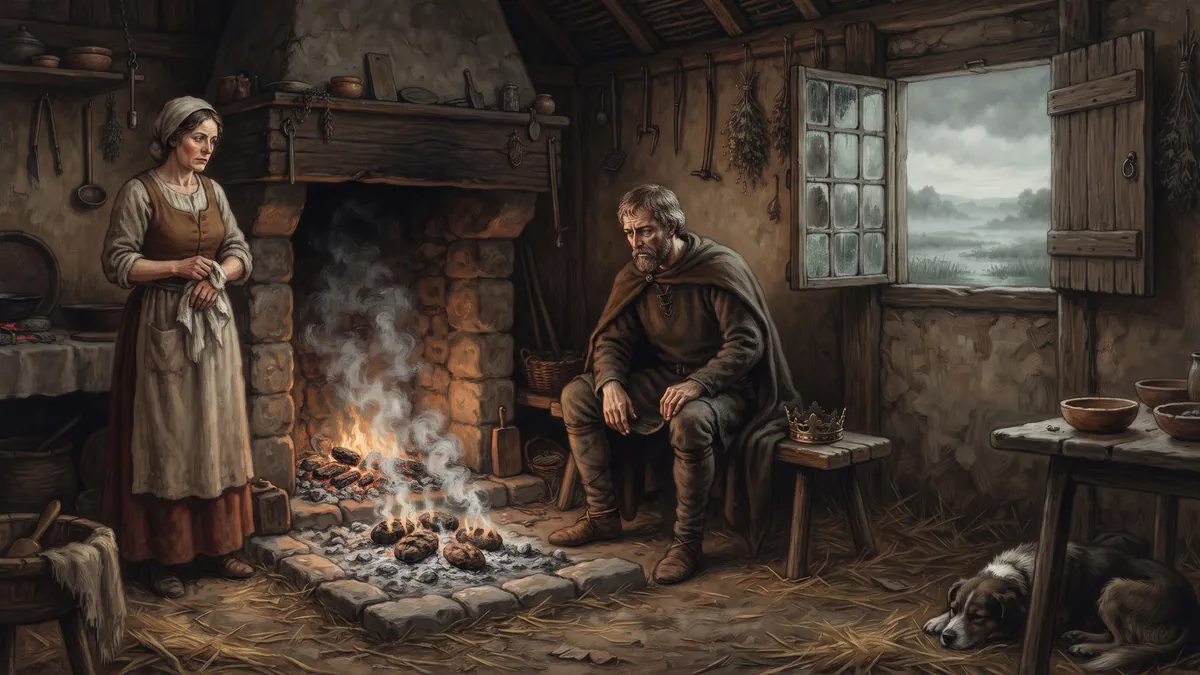
In January 878, King Alfred of Wessex was celebrating Twelfth Night when a Viking army appeared by surprise. The reaction was desperate: the court scattered, and Alfred escaped with a few men into the marshes. Months later, he would turn the tables.
The attack on Chippenham
Alfred had been king since 871. In the following years he bought peace with the Vikings, who held large parts of England. In 878, the Danish leader Guthrum broke the truce and attacked Chippenham, a royal residence, in midwinter.
The Anglo-Saxon Chronicle says that many of the population fled across the sea, and that most submitted. Alfred, with a small band, went to the Somerset marshes.
Athelney
According to the sources, Alfred took refuge on the island of Athelney, surrounded by flooded land. From there he made guerrilla raids on the Vikings and sent messages to his allies. The Chronicle says that in the seventh week after Easter he rode to Egbert’s Stone, where the men of Somerset, Wiltshire and Hampshire joined him.
Edington
The decisive encounter took place at Edington (Ethandun) in May 878. According to Asser, the Saxons fought in close formation and won. The Vikings fell back to the fortress at Chippenham, and Alfred besieged them for two weeks. Without food, Guthrum surrendered.
The settlement was unusual for the time. Guthrum agreed to be baptised, and Alfred was his godfather. Then the two defined a boundary that divided England, and the region to the north and east came to be governed by Danish law, the Danelaw.
The burnt cakes
One of the best-known stories about Alfred is that of the cakes. According to it, during his hiding he asked for shelter at a peasant woman’s house, and she asked him to watch the loaves on the fire. Alfred, distracted by the problems of the kingdom, let them burn and was scolded by her.
The legend does not appear in the earliest texts, neither the Anglo-Saxon Chronicle nor Asser. It emerges centuries later, in texts about St Neot. It is therefore regarded as tradition and not as fact. Even so it has survived because it shows a king who accepts a humble rebuke, which fitted the image of a just sovereign.
The scholar king
After the victory, Alfred reorganised the kingdom. He built fortifications, the burhs, which made defence easier. He reformed the army and created a fleet. He also encouraged the translation of books from Latin into Old English, because he thought education was in decline.
That is why he is the only English king called “the Great”. His merit lies less in the battle of Edington than in the work that came after.
To watch the cakes without burning them, play Alfred’s cakes.
Sources.
- Anglo-Saxon Chronicle (entries for the years 871 to 878)
- Life of King Alfred, by Asser (9th century)
- Encyclopedia entries on Alfred the Great and the Battle of Edington
- Late medieval texts on St Neot, where the cakes legend appears