Heimdall: the watchman who hardly sleeps and guards the rainbow bridge
The god who sees hundreds of miles and hears grass grow guards Bifröst, the bridge of the gods. At Ragnarök, the sound of his horn will give the final warning.
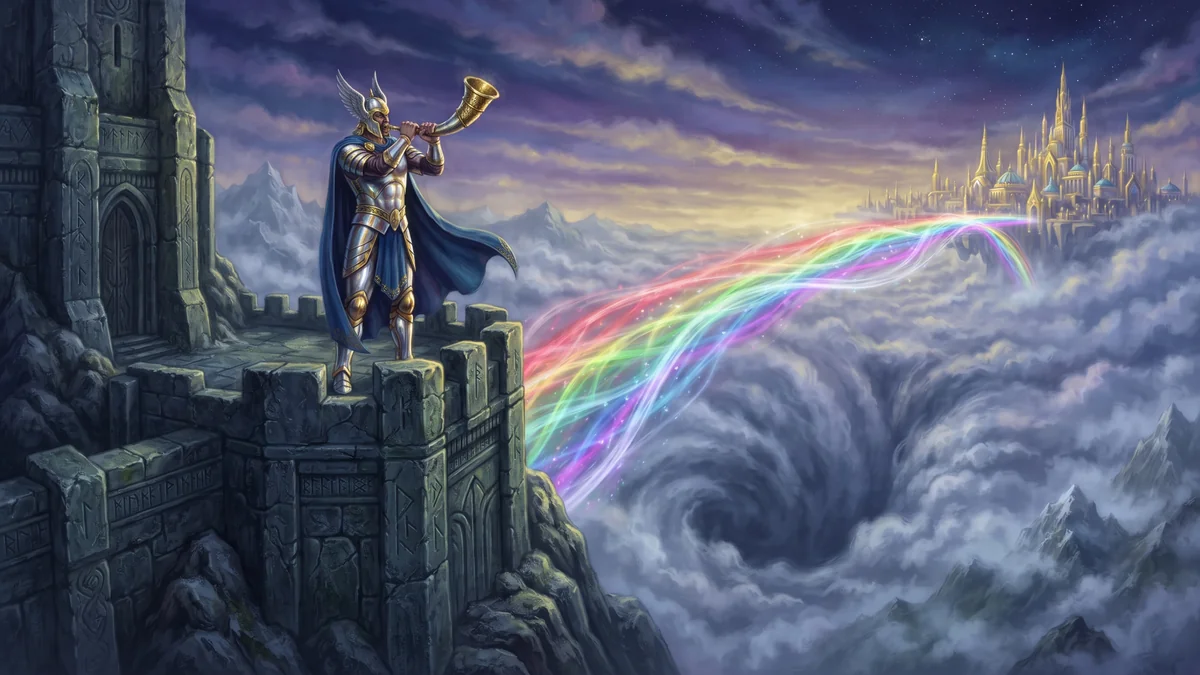
Among the Norse gods, Heimdall has a job that sounds simple: standing guard. He lives in Himinbjörg, a fortress on high ground at the end of Bifröst, the bridge linking the human world to Asgard. From there he watches whoever approaches.
The gods’ guard
The sources describe him as the ever-vigilant watchman of Asgard. He needs very little sleep and sees great distances, by day or night. His hearing is so sharp that, according to the texts, he hears grass growing on the earth and wool growing on sheep. That is why no one crosses the bridge without his noticing.
His equipment is a horn, the Gjallarhorn. When an intruder approaches, Heimdall blows it, and the sound is heard in all the worlds.
Nine mothers
Heimdall is described as a son of Odin and as born of nine mothers. The poem Heimdallargaldr, or the Völuspá hin skamma, speaks of these mothers without giving their names, and scholars have tried to link them to the nine daughters of Ægir, the sea god. The names do not match, however, and the question remains open.
A god of many riddles
Despite his clear role, the sources say little about him, and much of it is fragmentary. The meaning of the name Heimdallr is unknown. One of the poems, the Rígsþula, presents a character called Ríg who visits human homes and founds the social classes. Some readings identify Ríg with Heimdall, which would make him a kind of father of mankind, but that is interpretation and does not appear directly in the texts.
There is also an obscure verse in the Völuspá about Heimdall’s hljóð hidden beneath Yggdrasil and tied to the eye that Odin sacrificed. The word may mean hearing, horn or ear, and it is not known for sure whether the god also gave up something of himself.
The bridge and the end
Bifröst appears in the Prose Edda as the rainbow-shaped bridge over which the gods ride every day to the well of Urðr, where they hold court. It is also over it that, at Ragnarök, the giants will advance on Asgard.
When that happens, Heimdall will blow the Gjallarhorn to summon the gods. The Völuspá says that Loki, his old enemy, will fight beside the giants and that the two will kill each other. It is an end that fits the role: the watchman gives the last warning and falls defending his post.
Why he matters
Heimdall is the god of attention. In a world where the gods hold power but depend on someone to keep watch, he shows that watching is also a strength. For readers today, this is where the image comes from of the sentinel who never sleeps and is, at once, the first and the last to notice danger.
To repeat the sequence Heimdall plays on the horn, play The colours of Bifröst.
Sources.
- Völuspá, Völuspá hin skamma and Rígsþula (Poetic Edda)
- Gylfaginning, chapter 27 (Prose Edda, by Snorri Sturluson)
- Entries in encyclopedias and Nordic museums on Heimdall