The siege of Paris, 885–886: when the Vikings tried to sail up the Seine and met a bridge
For about a year, a large Viking fleet besieged Paris. The city, on its island, held out, and the story was told by an eyewitness monk, Abbo of Saint-Germain.
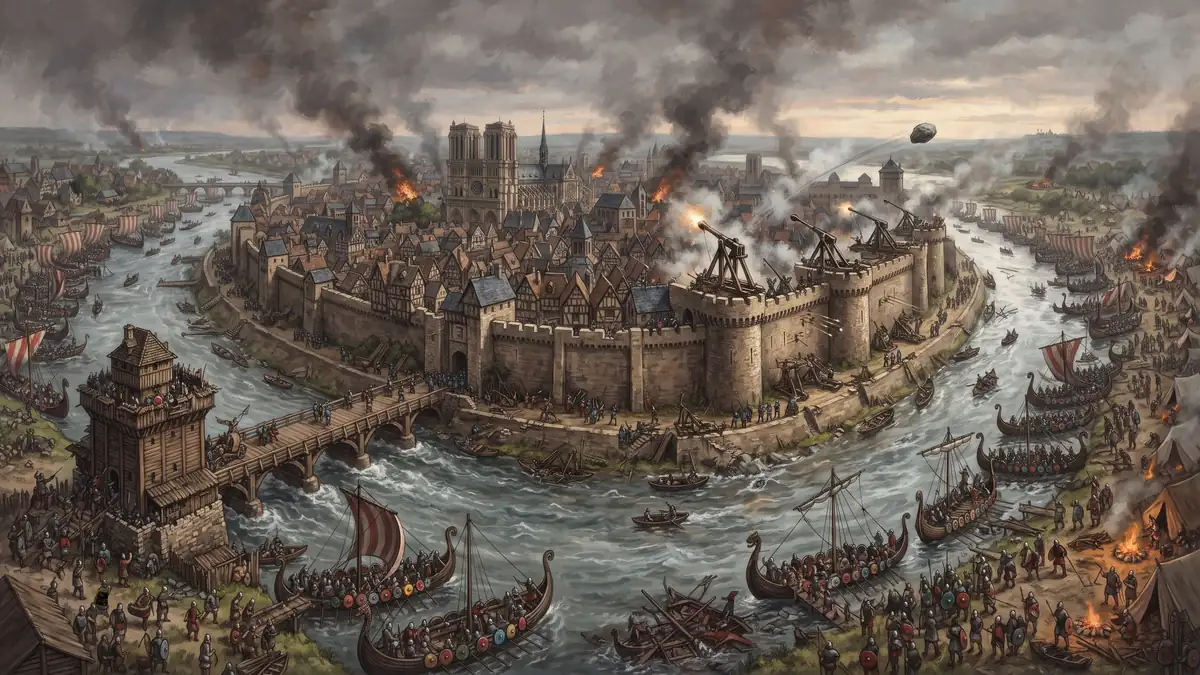
In November 885, a Viking fleet reached the River Seine and stopped before Paris. The city was small, occupying an island, the Île de la Cité, and it had two wooden bridges. But it lay in the way of anyone who wanted to sail upriver into the interior of Francia.
The fleet
The siege was narrated by Abbo, a monk of Saint-Germain-des-Prés, who was in the city. His poem, in Latin, describes an enormous fleet. Abbo speaks of seven hundred ships and more than thirty thousand men, but these numbers are seen as exaggeration. Scholars think a much smaller force likely, though still large for the time.
The leaders were Sigfred and Sinric, according to the sources. Sigfred went to the city and asked for passage upriver. Bishop Gozlin refused, and the reply opened the siege.
The defence
Paris was defended by Odo, count of the city, and by Bishop Gozlin. The north bridge had a newly built wooden tower that blocked the passage. The tower was the focus of the Viking attacks.
The attackers used siege engines and battering rams, and tried to burn the bridge with burning boats. The defenders replied with arrows, stones, hot oil and, according to Abbo, catapults. The city withstood several assaults.
A flood carried away part of the bridge, leaving the tower isolated. The defenders in it were eventually killed, and the Vikings advanced to the bank, but Paris held.
Gozlin dies, Odo stands out
Bishop Gozlin fell ill and died in April 886. Odo went to seek help from Emperor Charles the Fat and came back with promises. The emperor arrived only in October 886, with an army, but did not attack. He preferred to negotiate.
Charles paid the Vikings a sum of silver and allowed them to go up the Seine to raid Burgundy, which was rebellious. The decision was heavily criticised. The Parisians, who had resisted for a year, saw the emperor pay the enemy.
Consequences
The siege gave Odo great prestige. In 888 he was elected king of the West Franks, and his family later gave rise to the Capetian dynasty, linked to the city of Paris.
The Vikings kept attacking the region, and Francia only managed to rid itself of part of the attacks in 911, when it granted land to the chieftain Rollo, in the region that would become known as Normandy. That is a separate story, and a much better known one.
What is not known
Like almost all of the Viking Age, the siege is seen through Christian eyes. Abbo was a monk and praised the bravery of his own side. There are no Viking sources on the episode, and the poem’s numbers should be read with care.
To help defend the Paris bridge, play The catapult of Paris.
Sources.
- Bella Parisiacae urbis, by Abbo of Saint-Germain-des-Prés, c. 896–900
- Annals of St-Vaast and Annals of Fulda
- Encyclopedia entries on the siege of Paris (885–886)