Snorri Sturluson: the Icelander who saved the Norse myths and died for politics
Chieftain, poet and lawmaker, Snorri wrote the Prose Edda and the sagas of the kings of Norway in the 13th century. In 1241 he was killed at his home in Reykholt.
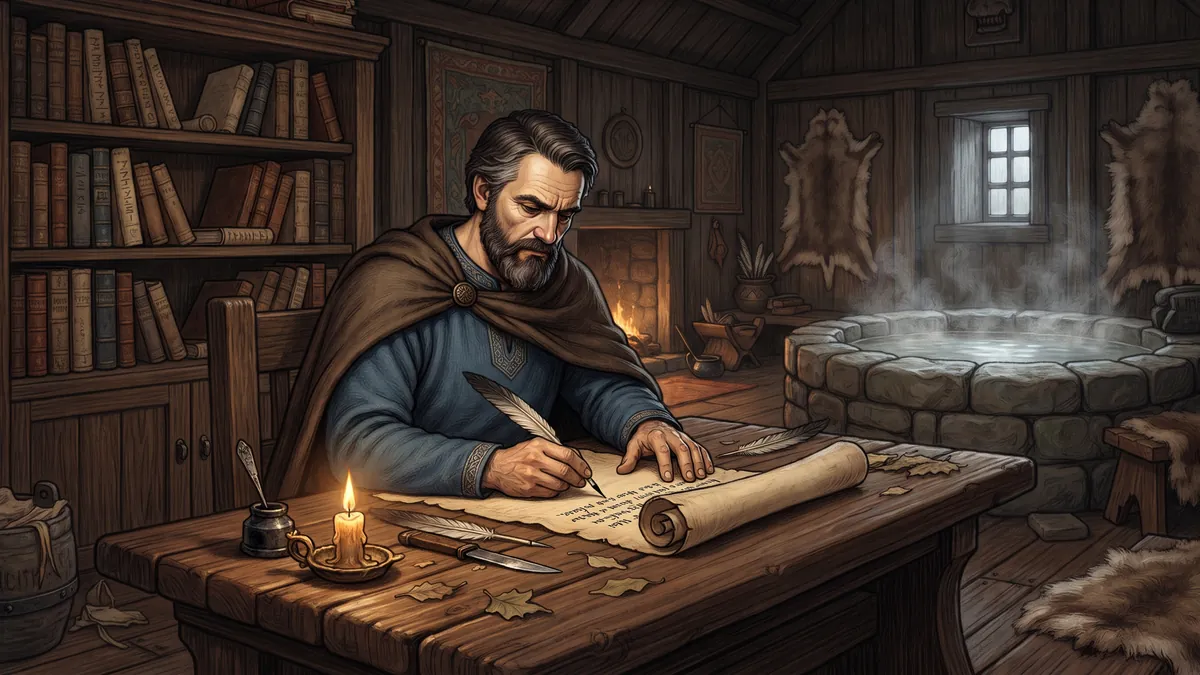
Almost everything the world knows about Odin, Thor and Loki in organised form comes from a man who did not believe in them. Snorri Sturluson, a 13th-century Christian Icelander, decided to write down the old myths so that the poets of his time would not forget them.
The boy from Oddi
Snorri was born in 1179 in western Iceland. At three he was sent to be fostered at Oddi, in the house of Jón Loftsson, one of the most powerful chieftains in the country and, according to tradition, a grandson of a Norwegian king. Oddi had books, and Snorri grew up among stories of kings and the verses of the old skalds.
He married well, grew rich and gathered land. He came to live at Reykholt, where he built a fortified house and a stone pool fed by hot water from a natural spring. The place can still be visited.
The poets’ book
The Prose Edda, attributed to him, was probably written around 1220. It is partly a handbook for poets. The skalds lived on intricate images, the kennings, in which the sea could be “the whale’s road”. Anyone who did not know the myths could not understand the poems. So Snorri decided to tell the myths.
The book has three parts. The Gylfaginning tells how a Swedish king asks three figures about the gods and the creation of the world. The Skáldskaparmál explains the language of the poets and includes many stories. The Háttatal analyses the metres of poetry.
Without this work, much of what we know about Ragnarök, Thor’s hammer or the mead of poetry might have been lost. The Poetic Edda, a collection of anonymous poems, also survived, but it is fragmentary and without context.
The kings of Norway
The longest work attributed to him is the Heimskringla, a collection of sagas of the Norwegian kings, from ancient legends to the 12th century. The name comes from its opening words, meaning “the circle of the world”. It includes Olaf Tryggvason, Saint Olaf and Harald Hardrada, among others.
Scholars also attribute Egil’s Saga to Snorri, on the basis of stylistic evidence. The authorship, however, is unproven, since Icelandic sagas were anonymous.
Politics and ruin
Snorri was elected lawspeaker of the Althing, the Icelandic parliament, which carried prestige. He held the office twice. In 1218 he went to Norway, where he received favours from the young king Haakon and from Duke Skúli, and came back promising to work for Iceland to draw closer to the Norwegian crown.
But Iceland was living through a time of struggle between great families, and Snorri ended up in the middle of disputes with relatives and rivals. His son-in-law and later his rival Gissur Þorvaldsson became enemies. When Skúli rebelled against Haakon and lost, the king considered Snorri a traitor.
In September 1241, Gissur and his men arrived at Reykholt at night. Snorri tried to hide in a cellar. According to the Íslendinga saga, written by his nephew Sturla Þórðarson, he was found and killed. The saga records the words eigi skal höggva, “do not strike”, attributed to him, but there is no way to know whether they were really spoken.
The legacy
Snorri was at once a Christian, an ambitious politician and the preserver of a religion that no longer existed. The very doubts about what he thought of the gods are part of the interest. Today a statue of him stands at Reykholt, and the small local museum tells the story of the man who wrote the North.
To train your memory like a skald, play Snorri’s pairs.
Sources.
- Prose Edda (Gylfaginning, Skáldskaparmál and Háttatal), attributed to Snorri Sturluson
- Heimskringla, attributed to Snorri Sturluson
- Íslendinga saga, by Sturla Þórðarson, in the Sturlunga saga collection
- Encyclopedia entries and the Árni Magnússon Institute on Snorri