Beowulf and the hall of Heorot: the English poem set in Scandinavia and the monster Grendel
The poem Beowulf was written in Old English, but tells a story of Denmark and southern Sweden. Its hero fights unarmed against the monster that attacks the king's hall.
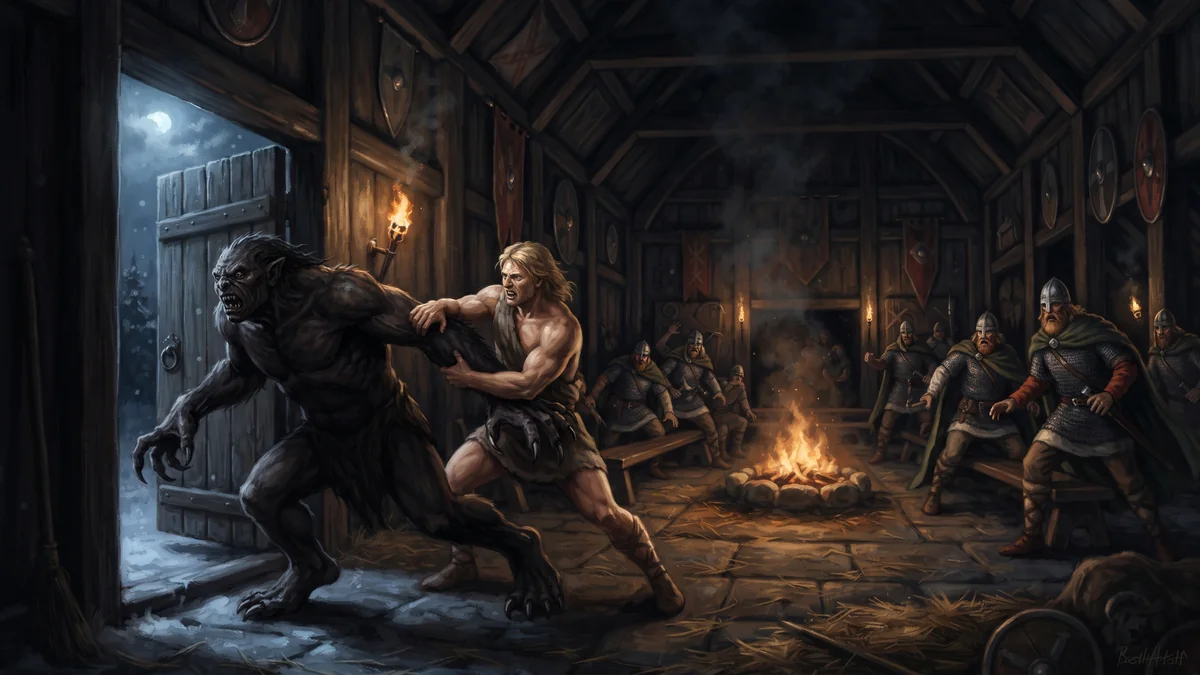
For twelve years a monster enters a great Danish hall at night and kills the warriors who sleep there. When a stranger arrives and decides to face it without a sword, the poem finds its hero.
An English poem about the North
Beowulf is the longest poem preserved in Old English, with more than three thousand lines. It survives in a manuscript from around the year 1000, and scholars debate whether it was composed much earlier, in the 8th century, or closer to the date of the manuscript. Though written in England, the poem is set in Scandinavia, in Denmark and southern Sweden, and speaks of kings and old wars of that region.
The monster and the hall
The Danish king Hrothgar builds a magnificent hall, Heorot, where his men drink and receive gifts. The sound of the feasts troubles Grendel, a monster who lives in the fens, a descendant of Cain according to the poem. Every night he attacks.
Beowulf, a warrior of the Geats, crosses the sea to help. He fights Grendel unarmed, grips his arm and tears it from the shoulder. The monster flees to die. The next day his mother attacks, and Beowulf kills her at the bottom of a lake.
The hero’s end
Years later, now king of the Geats, Beowulf faces a dragon that guarded a treasure and dies in the fight. The poem ends with his funeral, on a pyre by the sea.
Between fable and history
Monsters and dragons are fiction, but other parts of the poem touch on people and places that existed. King Hygelac, Beowulf’s uncle, appears in a 6th-century Frankish chronicle, by Gregory of Tours, in a raid against the Frisians. And archaeology found at Lejre, in Denmark, a large 6th-century timber hall, which tradition links to the power of the kings of that region.
No one can say that Heorot was that hall. But the poem shows that the hall was, for the Norse, the centre of life: the place of food, song and safety.
The manuscript and the poet
The only old manuscript of the poem, Cotton Vitellius A.xv, is now in the British Library. In 1731 a fire in the house where the collection was kept scorched the edges of the pages, and part of the text could only be read with the help of copies made afterwards. The poet’s name is unknown. In 1936 Professor J. R. R. Tolkien gave a famous lecture arguing that the monsters were the heart of the poem, not decoration.
To tear off Grendel’s arm before he escapes, play Grendel’s arm.
Sources.
- *Beowulf*, Old English poem (manuscript around the year 1000; date of composition debated)
- Gregory of Tours, *Historia Francorum* (6th century), on King Chlochilaicus
- Archaeological studies of the hall at Lejre, Denmark