Halfdan at Hagia Sophia: the runes a Norseman scratched into the marble of Constantinople
In a gallery of Hagia Sophia, in Istanbul, a runic inscription says that a man named Halfdan carved his name there. It is one of the rare direct traces of Norsemen in the city.
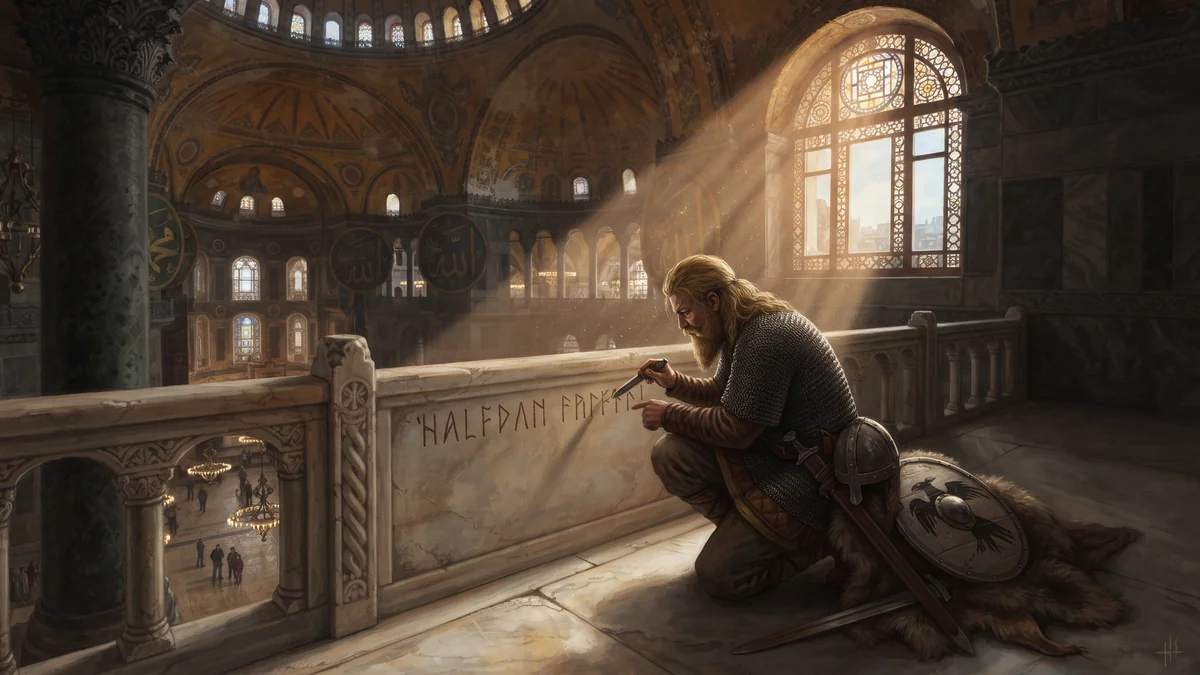
In Istanbul, in the upper gallery of Hagia Sophia, a marble parapet holds graffiti more than a thousand years old. It is written in runes, and it says that a man named Halfdan carved his own letters there.
What the inscription says
The inscription is on a marble parapet and bears the name Halfdan, followed, according to the most accepted readings, by a verb meaning “carved” or “scratched”. It is a short inscription, made with a blade, and resembles what visitors of any era leave on monuments. Its date is unknown, and specialists place it, cautiously, between the 9th and 11th centuries.
Norsemen in Constantinople
The Norse called Constantinople Miklagarðr, the “Great City”. The Rus’, linked to Scandinavia, attacked the city in 860 and later made trade agreements with the Byzantine Empire. In the late 10th century, Emperor Basil II received from Vladimir of Kyiv a body of warriors that would form the Varangian Guard, the emperor’s personal guard, recruited among Scandinavians and neighbouring peoples.
Halfdan may well have been one of those men, or a merchant, but the inscription does not say.
Other traces in stone
There are other runic inscriptions in the Byzantine world. The best known is the Piraeus Lion, a large marble statue taken from Athens and now displayed in Venice. Its bands of runes, from the 11th century, were read by some scholars as referring to a Harald, perhaps the future king Harald Hardrada, who served in Constantinople.
These short texts are valuable because they were written by the Norse themselves, not by outside chroniclers.
One name among millions
Hagia Sophia was built in the 6th century and afterwards served as a cathedral, a mosque, a museum and again a mosque. Millions of people have passed through it, and few know of Halfdan’s name in a corner of the marble. The inscription is a reminder that the great journeys of the Viking Age often ended in small gestures.
The stones of Greece
Hagia Sophia is not the only trace. Dozens of rune stones in Sweden, raised in memory of relatives, speak of men who set out for Grikkland, the Norse name for Greece and the Byzantine Empire. Some say the man died there, others that he came back rich. Added to Halfdan’s inscription, these stones show that the journey to Constantinople was known in many Scandinavian families, not only among chieftains.
To find the runes hidden in the marble, play Runes in Hagia Sophia.
Sources.
- Studies of runic epigraphy on the Hagia Sophia and Piraeus Lion inscriptions
- Historical research on the Varangian Guard in Constantinople, 10th and 11th centuries