Cnut the Great and the North Sea Empire: the king who ruled England, Denmark and Norway
Between 1016 and 1035, Cnut gathered the crowns of England, Denmark and Norway. Here is how it happened and what lies behind the story of the waves.
Few kings of the 11th century ruled as much sea as Cnut (Knud in Danish, Canute in English). Between 1016 and 1035, he was king of England, Denmark and Norway. Historians use the name “North Sea Empire” for this group, although his contemporaries did not call it that.
The road to England
Cnut’s father, the Danish king Sweyn Forkbeard, conquered England in 1013 and died soon after. Cnut was driven out, but returned in 1015 with a large fleet. He fought Edmund Ironside, son of the English king Æthelred, and defeated him at the battle of Assandun, in 1016. Soon afterwards, Edmund died, and Cnut became king of all England.
In 1017, he married Emma of Normandy, widow of Æthelred. In 1018, the Anglo-Saxon Chronicle records an enormous tribute levied on the English, of more than 70,000 pounds of silver, besides what London paid separately. Most of the fleet was dismissed. Cnut governed with English laws, supported the Church and presented himself as a Christian king.
Denmark and Norway
In 1018, Cnut’s brother Harald died, and Cnut took Denmark as well. In 1027, he travelled to Rome to attend the coronation of Emperor Conrad II, and from there wrote a letter to the English people, which tradition preserved. In 1028, he took Norway, after forcing King Olaf Haraldsson to flee. Olaf died at Stiklestad in 1030, when he tried to recover the throne.
The chair by the sea
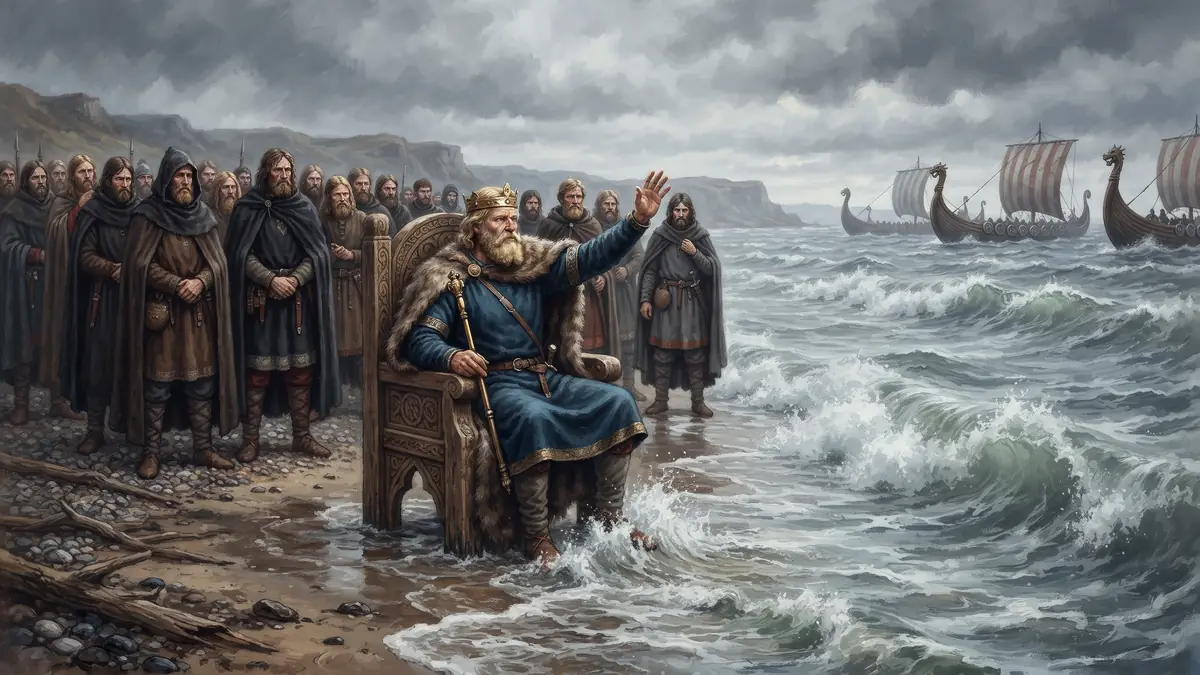
The best-known story about Cnut is that of the waves. According to Henry of Huntingdon, who wrote around 1129, Cnut had a chair placed at the water’s edge and ordered the tide not to rise. The water wet his feet. For the chronicler, the king wanted to show his courtiers that the power of kings is small before divine power. The version that makes him an arrogant fool is later. The exact place is uncertain, and local traditions compete for the credit.
After him
Cnut died in 1035 and was buried at Winchester. His empire did not survive. His sons disputed the crown, and in 1042 a king of the English line, Edward the Confessor, returned to the throne. Norway also slipped out of Danish control around the same time.
Laws, earls and skalds
Cnut kept English laws, and England had law codes issued in his name, drafted with the help of churchmen, among them Archbishop Wulfstan of York. He divided the kingdom into large earldoms governed by earls. Some were Danish, others English, like Godwin, who received the title around 1018. Skalds composed poems in his honour, and some verses were preserved in the kings’ sagas. The Encomium Emmae Reginae, written for Queen Emma, shows how the court wished him to be remembered. But the peace depended on the king’s personal strength, and without him the arrangement was fragile.
To keep the empire together, absorbing kingdom after kingdom into one, play Cnut’s waves.
Sources.
- *Anglo-Saxon Chronicle* (compiled between the 9th and 12th centuries), entries for 1013 to 1035
- Unknown author, *Encomium Emmae Reginae* (around 1041–1042)
- Henry of Huntingdon, *Historia Anglorum* (around 1129)