The war between Æsir and Vanir: the first war in the world and the exchange of hostages that brought peace
The Norse poems speak of a war between two groups of gods that ended in a deal and an exchange of hostages. See what the Völuspá and Snorri tell, and where the sources differ.
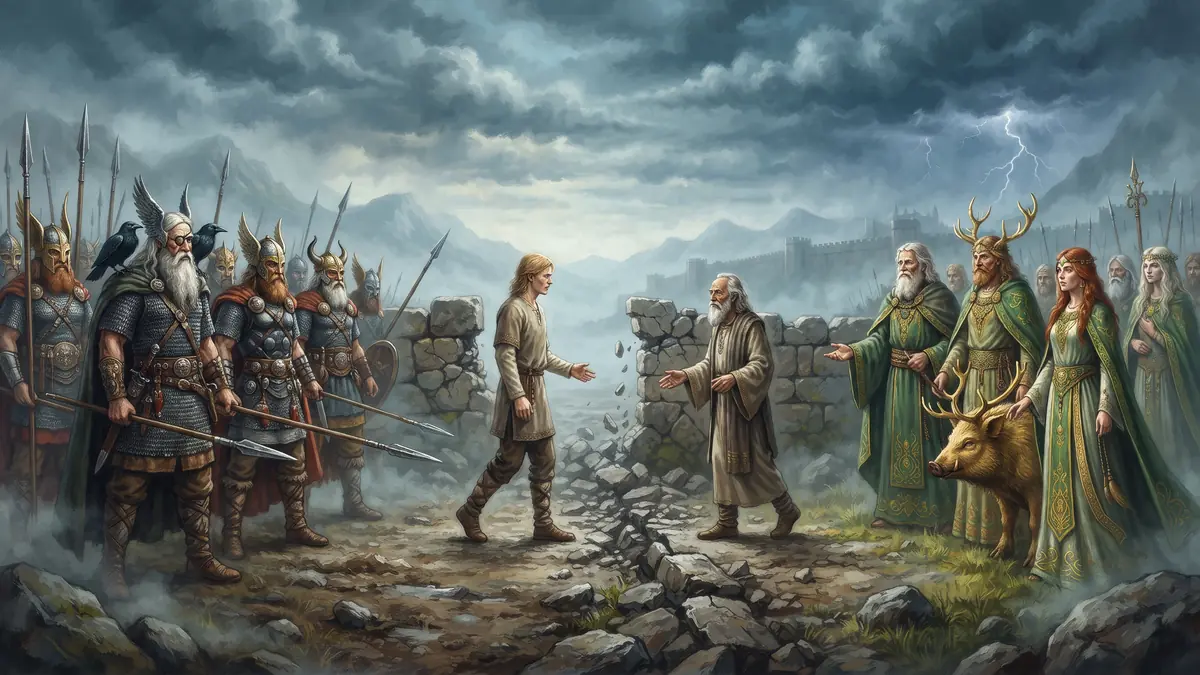
The Norse gods do not form a single family. There are two main groups, the Æsir, who include Odin and Thor, and the Vanir, such as Njörðr, Freyr and Freyja. The sources keep the memory of a war between them, the first in the history of the world, which ended in an unusual peace.
The war according to the Völuspá
The oldest account comes from the Völuspá, a poem of the Poetic Edda preserved in 13th-century manuscripts. In stanzas 21 to 24, the seeress tells that a woman called Gullveig was pierced with spears and burned three times in Odin’s hall, but kept on living. Then, says the poem, Odin hurled his spear over the host, and that was the first war in the world.
The poem also says that the Vanir broke the wall of the Æsir and that the battlefield lay open. The seeress does not explain who Gullveig was or why she was attacked, and scholars debate whether she might be Freyja or another figure tied to the Vanir.
Peace and hostages
The settlement of the war appears in Snorri’s Ynglinga saga. Tired of a fight neither side could win, the two groups made peace and exchanged hostages. The Vanir sent Njörðr and his son Freyr to the Æsir. The Æsir sent Hœnir and Mímir to the Vanir.
Snorri says the Vanir gave Hœnir the leadership among them, but noticed that he only decided well when Mímir was beside him. Without the adviser, Hœnir always answered that others should decide. The Vanir, feeling cheated, cut off Mímir’s head and sent it to the Æsir. Odin kept it, according to the story, and began to consult it.
Njörðr and Freyr, by contrast, were well received and became priests of the sacrifices. In another passage of the Prose Edda, Snorri tells that when the peace was sealed the gods spat into a vat, and from that spittle Kvasir was born, a being so wise that he answered any question.
What does it mean?
For over a century, scholars have debated the meaning of the war. One thesis, defended by authors such as Georges Dumézil, sees it as a reflection of a division between social functions, with the Æsir tied to war and sovereignty and the Vanir to fertility and wealth. Another considers it a memory of real conflicts between peoples, which has no proof. Neither is accepted by everyone.
What is known is that the sources are late, written by Christians in the 13th century, and that Snorri tends to treat the gods as human kings who later became divinities, which is called euhemerism. His version may therefore have been tidied to fit a logical story. The oldest thing the Völuspá has is only the fragment of the war, without the peace.
To help both sides reach a fair deal, dividing the gifts into equal parts, play The scales of peace.
Sources.
- Unknown author, *Poetic Edda* (*Völuspá*, stanzas 21 to 24, 13th-century manuscripts)
- Snorri Sturluson, *Ynglinga saga*, in *Heimskringla* (c. 1230)
- Snorri Sturluson, *Prose Edda* (*Skáldskaparmál* and *Gylfaginning*, c. 1220)