Håkon the Good and the poem that sent him to Valhalla: the battle of Fitjar according to the saga and the skald
King Håkon, raised at the English court, died after the battle of Fitjar. The saga describes a good king, and the skald Eyvindr welcomes him to Valhalla. See what the sources say.
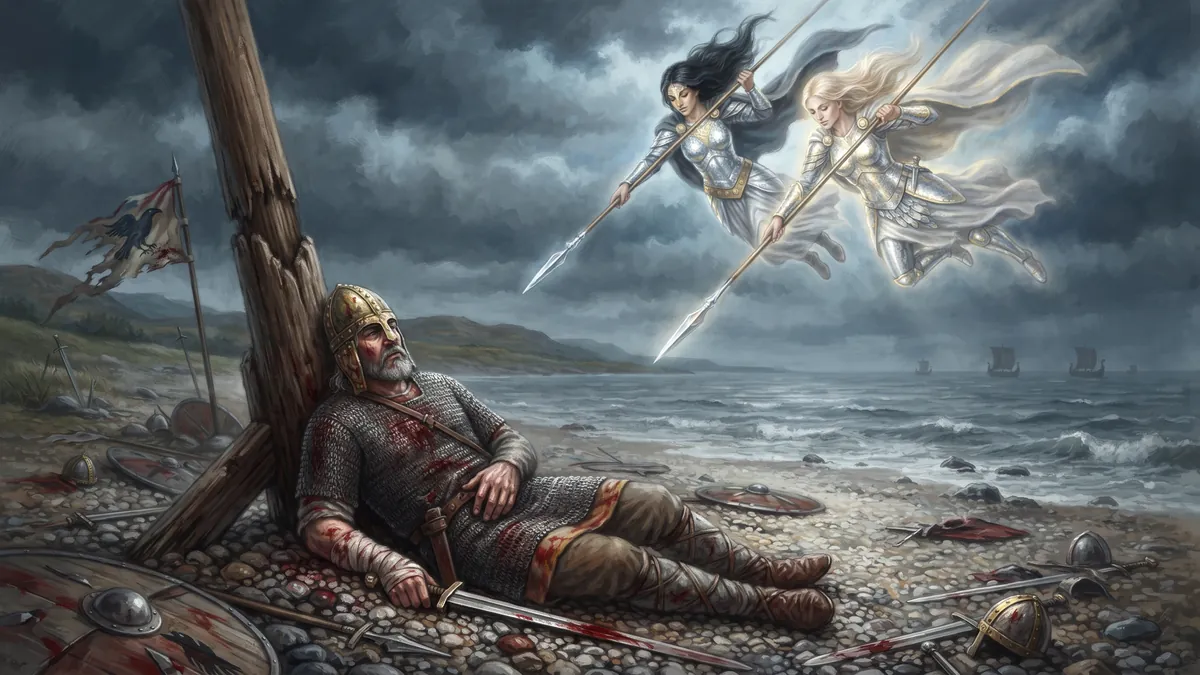
Håkon Haraldsson, son of Harald Fairhair, was given the epithet “the Good” by tradition. His death is told by two very different sources, a 13th-century prose saga and a poem composed, by tradition, soon after the events.
A king raised in England
According to Snorri Sturluson’s Heimskringla, Håkon was sent as a child by his father to the English king Æthelstan and was raised at his court. He returned to Norway after Harald’s death, overthrew his half-brother Eirik Bloodaxe and was acclaimed king. Snorri tells that he had arrived a Christian but, without the chieftains’ support, agreed to take part in pagan sacrificial feasts so as not to lose the kingdom. He made laws for the þing, the assemblies, and organised coastal defence with ships supplied by districts.
Fitjar
Eirik’s sons, backed by the king of Denmark, attacked Norway. The battle of Fitjar, on the island of Stord, took place around 961, according to tradition, and Håkon won. Snorri tells that at the end of the fighting an arrow struck him in the arm. He still ordered them to take him to his estate at Alrekstad, where he died, on the rock later known as Håkonshella.
Snorri says the king died a Christian and that friends and enemies wept for him. The saga is a work from centuries later, and historians use its details with care, but Håkon’s existence and the date of his death are accepted.
The skald’s poem
The skald Eyvindr Finnsson, nicknamed skáldaspillir, “the spoiler of poets”, for imitating others’ verses, composed the Hákonarmál, a poem in the king’s honour. Snorri quotes many of its stanzas. In them Odin sends two valkyries, Göndul and Skögul, to choose among kings who should go to Valhalla. Håkon, after the battle, rides with them, and the god sends two of his men to receive the king. He is wary of Odin and says he would rather keep his weapons and armour, but he is welcomed.
Eyvindr, as far as we know, was a pagan, and the poem turns the king’s death, which Snorri calls Christian, into a journey to the warriors’ paradise. Scholars debate whether the skald ignored the king’s faith or whether the Christian legend is later. The poem at least shows how the death of a good chieftain was remembered: with honour and mourning.
What this shows
Two sources tell the same death with different values, and neither contradicts the other in essentials: Håkon was a respected king, overcome by a battle wound. The sources do not allow saying more.
That is why it is worth reading the two sources together: the saga shows what a Christian chronicler of the 13th century thought worth noting, and the poem what a poet close to the king thought worth singing after his death.
To try to clear the battlefield, removing shields by colour before the day ends, play The shields of Fitjar.
Sources.
- Snorri Sturluson, *Heimskringla* (*Hákonar saga góða*, c. 1230)
- Eyvindr Finnsson skáldaspillir, *Hákonarmál* (skaldic poem composed c. 960)
- Research on 10th-century Norway, the unification of the kingdom and Christianisation