Stállo: the foolish giant of the Sámi tales, who always loses to the cunning of those he wants to devour
In Sámi tales, Stállo is a being of iron and hunger who chases people but is almost always tricked by someone cleverer. See what the tradition tells and how scholars read it.
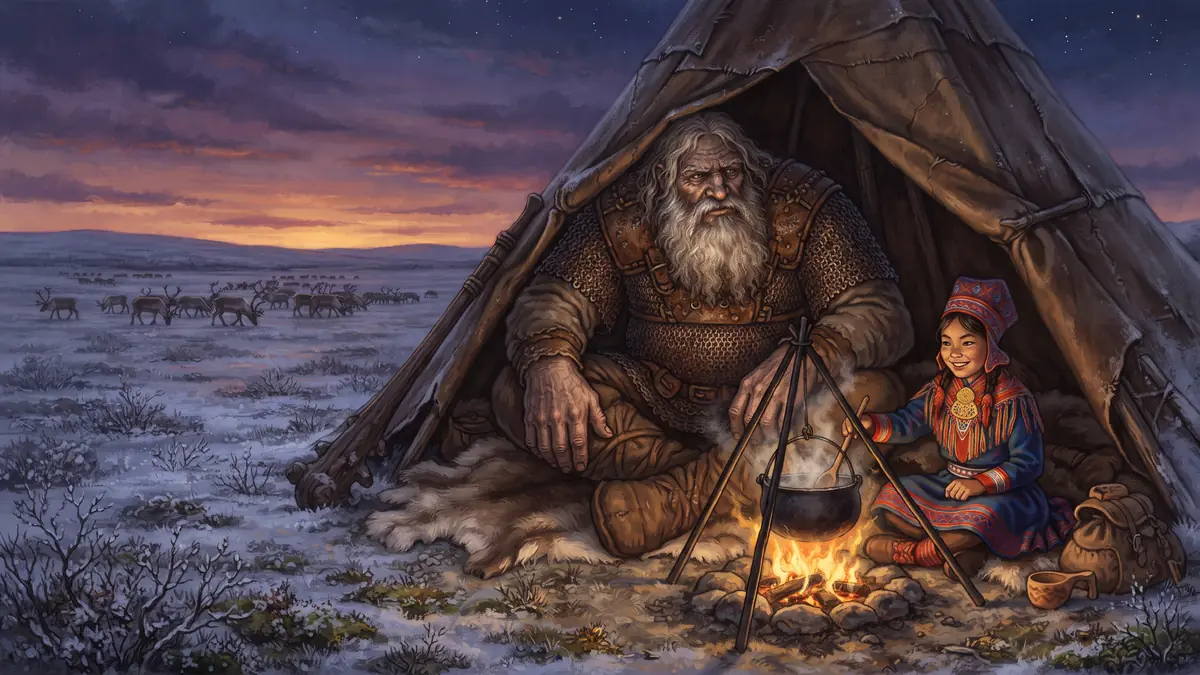
Many peoples have tales of giants who eat people, but few mix fear and humour as the Sámi tales about Stállo (in Northern Sámi, Stállu) do. He is a figure who appears in oral narratives recorded and studied since the late 19th century, and who is still remembered today.
Who Stállo is
In the tales, Stállo is a strong and fierce being who lives in a remote place and chases people, often with the idea of devouring them. He is usually described with clothes of iron or metal, a big sword or knife and a great hunger. He generally has a wife and a house with riches.
What sets him apart from a simple monster is that he is almost always slow of thought. The main figure of the tales, an ordinary Sámi person, often a boy or a woman, escapes through cunning. A well-known story has Stállo tricked into falling into boiling water or hurting himself, without understanding what is happening. The storyteller laughed at the giant’s slowness and rejoiced at the small one’s victory.
Where the stories were recorded
Sámi tales were passed on orally for generations. In the early 20th century researchers such as Just Qvigstad, who published Lappiske eventyr og sagn between 1927 and 1929, gathered a great number of narratives. The tradition is not one: each region and each storyteller had their versions.
It is important to remember that terms used in the past, such as “Lapp”, are now seen as inappropriate, and the Sámi themselves prefer to be called by the name they use. Many of the records were made by non-Sámi researchers, and present-day scholars also value the Sámi voices that tell and interpret the stories.
What researchers say
There are several readings. One sees in Stállo a figure of fear that served to teach children to be careful of the dangers of nature and of strangers. Another suggests, as a hypothesis, that he reflects memories of encounters with richer, armed neighbouring peoples. Neither can be proved, and the folklorist can only compare versions.
In archaeology there is a type of site called a stállotomt, a large, rectangular house with a hearth in the middle, found in several parts of Sápmi, the traditional region of the Sámi. The name comes from popular tradition, which attributed these ruins to the giant. Researchers interpret them as Sámi dwellings of past centuries, unrelated to giants.
A giant who teaches
For those who tell it, the giant is a way of speaking of limits: what is brute force and what is intelligence, what one has and what one does. The moral of the small one who wins remains, and the giant serves as a mirror for vanity.
To reach the end of the path without being seen when the giant looks back, play Stállo’s trail.
Sources.
- Just Qvigstad, *Lappiske eventyr og sagn* (collection of Sámi tales, published 1927–1929)
- Folklore studies on Sámi oral tradition and its supernatural beings
- Archaeological research on the so-called *stállotomter*, Sámi houses in Sápmi