Brunanburh, 937: the battle where an English king faced Vikings, Scots and Britons
In 937, King Æthelstan defeated an alliance of the Viking king of Dublin, the king of the Scots and the king of Strathclyde. We know the battle's name, but not its exact place.
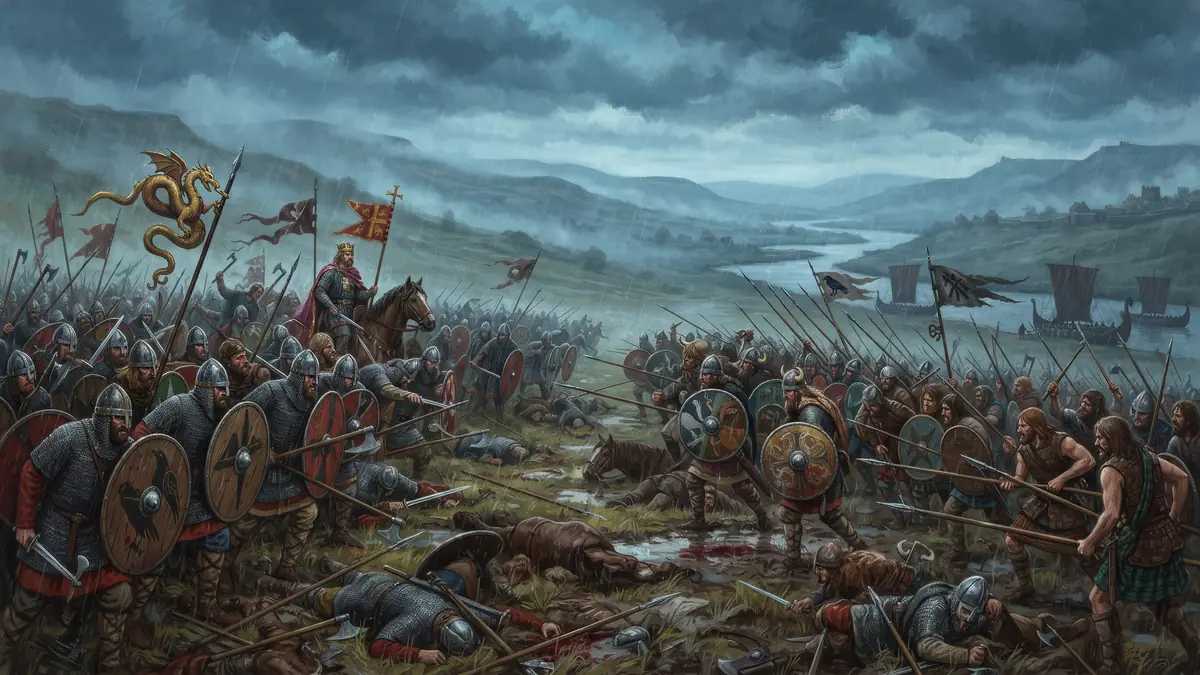
The battle of Brunanburh, fought in 937, is one of the few of the early Middle Ages whose name everyone knew, and whose place no one can point to with certainty. The sources are spread across at least three languages and make clear that it was a confrontation on a large scale.
An alliance against Æthelstan
King Æthelstan, grandson of Alfred the Great, ruled most of what is now England. In 927 he had taken York, which had been in Viking hands. In 937 an alliance formed against him. Its members were Olaf Guthfrithson, Viking king of Dublin, Constantine II, king of the Scots, and Owain, king of Strathclyde, in the south-west of present-day Scotland. The allies entered England by sea and by land.
The Annals of Ulster, an Irish chronicle, record a “great, lamentable and horrible” battle in which “countless thousands of Northmen” fell. They also say that Olaf escaped with few men and returned to Ireland.
The poem of the Chronicle
The Anglo-Saxon Chronicle records the victory with a poem, “The Battle of Brunanburh”. It praises Æthelstan and his brother Edmund, says five young kings and seven of Olaf’s earls were left dead on the field, and tells how the invaders fled in their ships over the Irish Sea. The verses carry a tone of triumph and, at one point, compare the battle to the great ones of English history. It is a text of propaganda, and we should read it as such.
The Icelandic saga of Egill Skallagrímsson, written centuries later, includes a similar battle, named Vínheiðr. According to it, Egill and his brother Þórólfr fought beside Æthelstan, and Þórólfr died there. Many scholars identify the saga’s battle with Brunanburh, but the saga is late, and its topography hard to check.
Where was it?
The site of Brunanburh has never been identified with confidence. Dozens of places have been proposed, among them Bromborough, on the Wirral peninsula in north-west England, and others in the north and around the Humber. There is no consensus, and no battlefield has been excavated conclusively.
For historians, what matters is the result. Æthelstan consolidated his rule, and the alliance against him broke up. But the victory was not final: Olaf Guthfrithson would return to England in 939, after Æthelstan’s death, and take York.
The battle also matters for what it reveals about the alliances of the time. A Viking king of Dublin, a Scottish king and a British king of Strathclyde joined together against a Saxon king, which shows that the political map of the British Isles was not divided only between Vikings and English. English sources gave the victory a special place in memory, and the Chronicle recorded it in verse, in the poem we cited above.
To win the field piece by piece, turning the opponent’s squares as in a battle, play The field of Brunanburh.
Sources.
- *Anglo-Saxon Chronicle* (annal for 937, including the poem "The Battle of Brunanburh")
- *Annals of Ulster* (annal for 937, medieval Irish chronicle)
- Michael Livingston (ed.), *The Battle of Brunanburh: A Casebook* (University of Exeter Press, 2011)