Hel and Helheim: the queen of the dead who lived in a house where Hunger was the plate
According to Snorri Sturluson, Hel, a daughter of Loki, ruled those who died of sickness or old age in an underground realm where even the tableware had grim names. Here is what the sources say.
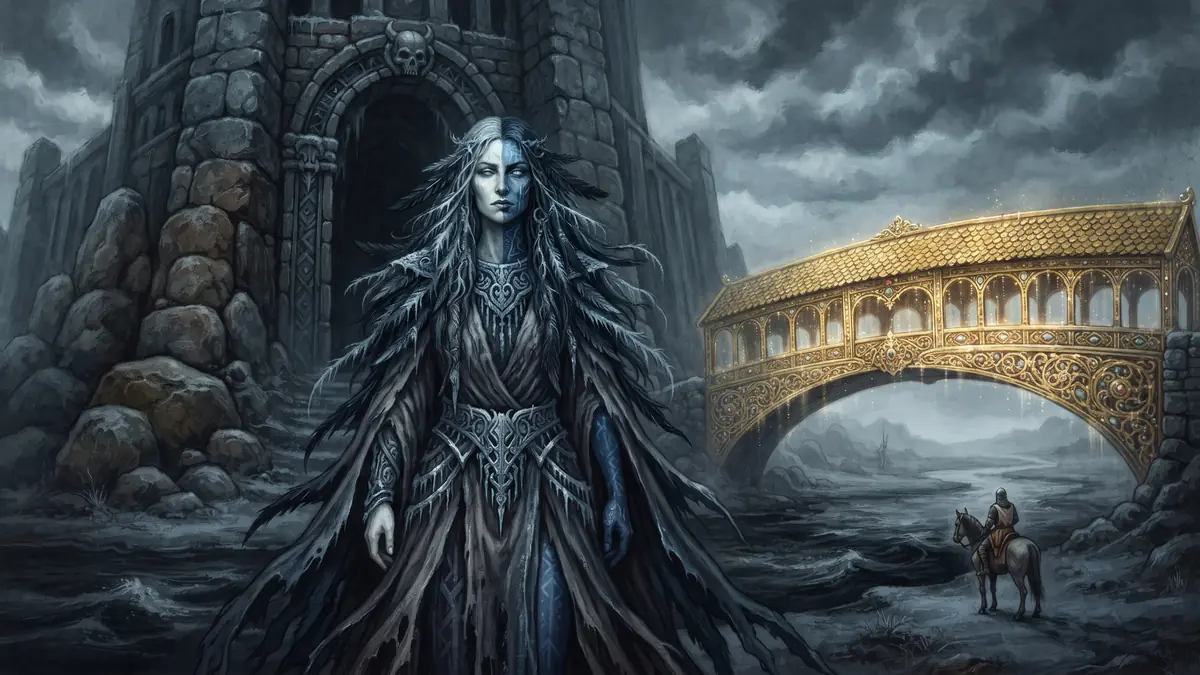
Not every dead Norseman went to the hall of heroes. For most, the destination was Hel, an underground realm ruled by a goddess of the same name. The sources describe the place without painting it as a punishment, but also without any comfort.
Who Hel was
According to the Gylfaginning by Snorri Sturluson, written around 1220, Hel was the daughter of Loki and the giantess Angrboða, sister of the wolf Fenrir and the Midgard Serpent. The gods knew the three would be trouble. Odin cast Hel into Niflheim and gave her power over nine worlds, so that she would receive those who died of sickness or old age. Those who fell in battle had another fate, tied to Odin.
Snorri describes her with half her body the colour of flesh and half dark blue, with a downcast look and a grim appearance. Her house, Éljúðnir, is surrounded by names that sound like a sentence: the plate is called Hungr, “hunger”; the knife, Sultr, “starvation”; the bed, Kör, “sickbed”; the threshold, Fallandaforað, “the danger of falling”.
The road to the realm of the dead
The best-known journey to Hel is that of Hermóðr, a son of Odin. When Baldr died, Hermóðr mounted the horse Sleipnir and rode nine nights through valleys so dark he could see nothing. He reached the river Gjöll and the bridge Gjallarbrú, covered in shining gold and guarded by the giantess Móðguðr. She told him that the day before, five companies of dead men had crossed, and the bridge had rung less under them than under him alone. It was the remark of someone who knew Hermóðr was still alive.
Past the bridge, Hermóðr came to the gate of Hel and jumped it on horseback. Hel agreed to release Baldr, but on one condition: everything, living and dead, had to weep for him. Everything wept, except a giantess who called herself Þökk. Baldr stayed where he was.
What the sources do not say
The Völuspá, a poem of the Poetic Edda, mentions the hound Garmr, who howls before the cave Gnipahellir as the end of the world draws near. Many scholars read him as a guard dog of the realm of the dead, but the poem does not put it in those words. The same work names a place called Náströnd, the “shore of corpses”, where oath-breakers and murderers suffer. Specialists debate how much of this picture comes from Christian influence.
Care is needed with Snorri. He was an Icelandic Christian of the 13th century, collecting the myths of a religion no longer practised. The portrait of Hel as an underground realm, similar to the Christian hell, may reflect that setting. The name itself comes from a Germanic root meaning “to hide”, and is related to the English word hell. In the oldest sources, to go “to Hel” simply means to die.
To cross the darkness of Helheim without getting lost, guided only by the light of a torch, play The torch in Helheim.
Sources.
- Snorri Sturluson, *Prose Edda* (*Gylfaginning*, chapters on Hel and on Hermóðr's journey, c. 1220)
- Unknown author, *Poetic Edda* (*Völuspá*, stanzas on Garmr and Náströnd, 13th-century manuscripts)
- Rudolf Simek, *Dictionary of Northern Mythology* (D. S. Brewer, 1993, entry "Hel")