Ingvar's stones: the Swedish expedition to Serkland that was carved in stone
About two dozen Swedish runestones remember the men who set out with Ingvar around 1036 and died far away. One says they went in search of gold. Here is what the stones and the saga tell.
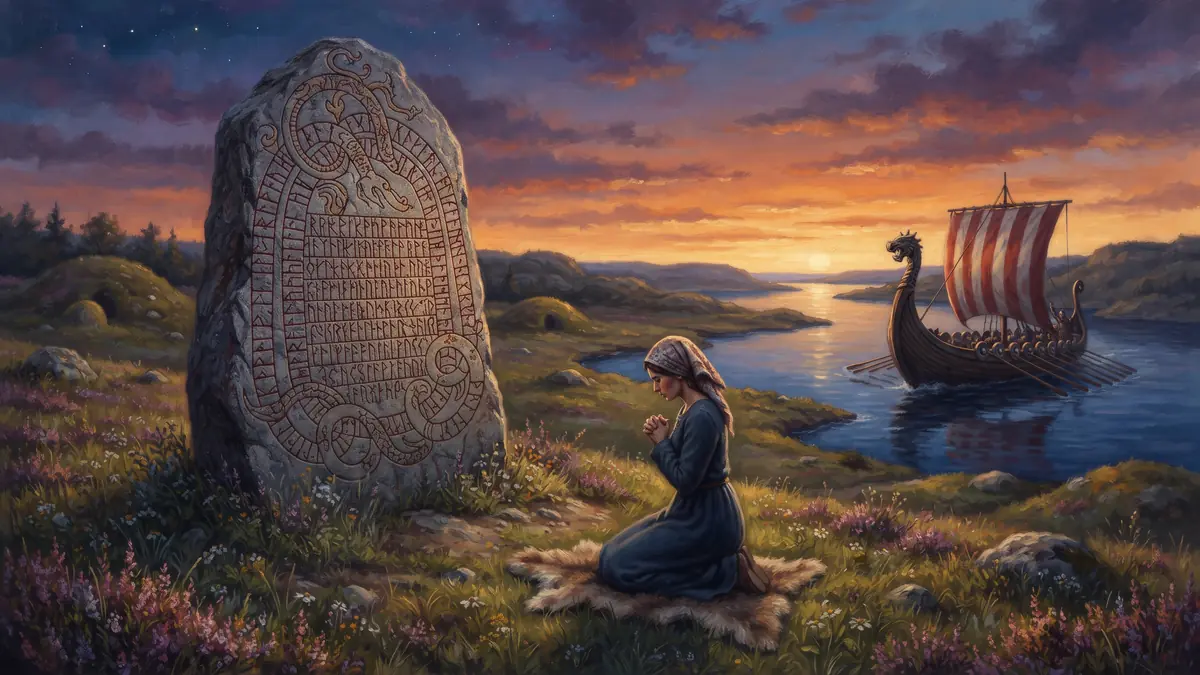
When a Swede of the 11th century died far from home, his family sometimes raised a stone to remember him. Some of these stones say where he died. A group of them points to the same place, far to the south-east, and to the same leader: Ingvar.
What the stones say
In the region of Lake Mälaren, in central Sweden, about two dozen and a half runestones have been identified as linked to an expedition led by a man called Ingvar. The most famous is the Gripsholm stone, which now stands beside the castle of the same name. It was raised by a woman, Tóla, for her son Haraldr, Ingvar’s brother. The text says, in short: “They travelled bravely, far, after gold, and in the east gave food to the eagle. They died in the south, in Serkland.”
Serkland was the Norse name for the lands south and south-east of the Caspian Sea, and the word is usually understood as “land of the Saracens”. “To feed the eagle” is an expression in Norse poetry for dying in combat, leaving the body to the birds.
The saga of Ingvar
The Yngvars saga víðförla, “the saga of Ingvar the Far-Travelled”, was written in Iceland in the 13th century and tells of this expedition. According to it, Ingvar set out from Sweden, crossed Russia and went to Serkland, where he faced dragons and strange creatures. The saga says he died of illness after years of travel, and that his companions died along the way. The expedition is usually dated between 1036 and 1041, on the basis of Icelandic annals and the dating of the stones. The saga’s adventures are, for the most part, literature.
The match between the stones and the Icelandic text is interesting. The stones are almost contemporary with the events, and the saga was written about two centuries later. Specialists see the saga as a work that reuses a real memory and adds fantastic episodes.
A society that wrote in stone
Ingvar’s stones show what Swedes of the time valued: the long voyage, gold and death far from home. Those who commissioned them were nearly always relatives: mothers, brothers and widows. The name of the dead man is carved beside that of whoever honoured him. Many of these inscriptions were painted, and today only the grooves remain.
We do not know what the expedition really was. No trace of Ingvar has been identified in Serkland. But Tóla’s stone, still standing, tells us what a mother chose to remember.
Ingvar’s stones are also useful to linguists, because they preserve forms of the language spoken in 11th-century Sweden and names of people who appear in no other source. That is why the reading of the runes, done by specialists in databases such as the one at Uppsala, helps us understand not only the expedition, but also the lives of the families who remembered it.
To carve the runes into the stone, filling the right squares according to the clues of each row and column, play Runes on the stone.
Sources.
- Unknown author, *Yngvars saga víðförla* (Icelandic saga, 13th century)
- Sven B. F. Jansson, *Runes in Sweden* (Gidlunds, 1987)
- Samnordisk runtextdatabas (Rundata, Uppsala University), inscriptions Sö 179 and related