Berserkers: the bearskin warriors, the fury the sagas describe and the Icelandic law that banned it
Poems and sagas speak of warriors who fought in a trance, biting their shields. No early source mentions mushrooms, an idea that only appeared in 1784.
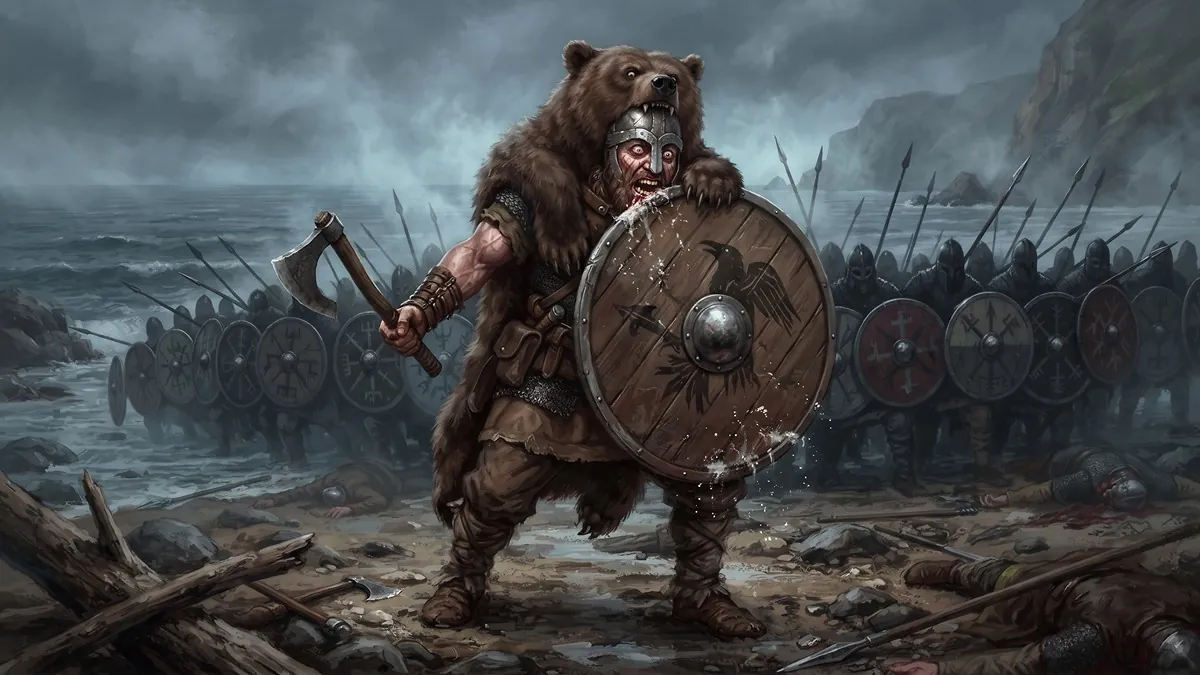
Berserker is the word the Norse sagas use for a kind of warrior who went into combat in a state of fury, without armour, howling and biting his own shield. The image is famous and it is, in part, true: it appears in poems and in sagas. But much of what is said today about berserkers is supposition, and the explanation that they ate mushrooms has no support in any early source.
What the poems and sagas say
The oldest source is the poem Haraldskvæði, by Þorbjörn Hornklofi, composed around the year 900 for King Harald Fairhair. Describing the battle of Hafrsfjord, the poet says that the berserkers roared and the úlfheðnar, “wolf-skins”, howled and shook iron spears.
Snorri Sturluson, in the Ynglinga saga, written around 1230, gives Odin men like this: they went to battle without mail, mad as dogs or wolves, bit their shields, were strong as bears or bulls and killed men without fire or iron harming them. Snorri gives this state the name berserksgangr, “going berserk”.
Bearskin or shirtless?
The origin of the word is debated. One reading is “bearskin”, from ber, bear, and serkr, shirt. Another is “bare-shirt”, that is, without armour. Both have defenders, and the sources do not settle the matter. The úlfheðnar, in turn, would be warriors in wolf-skins. Bronze plates found at Torslunda, on the Swedish island of Öland, from before the Viking Age, show a man with the skin and head of a wolf, and some researchers connect them to these warriors.
Heroes or thugs
In the Icelandic sagas, written much later, berserkers are often not heroes. They appear as bullies who arrive at a farm and challenge the owner to a duel, to take his daughter or his goods, as in Egils saga. A saga hero generally ends up killing them.
The law also treated them as a problem. The Grágás, the collection of laws of medieval Iceland, provides a penalty of lesser outlawry for anyone who went berserksgangr. By this record, the state was seen as dangerous rather than as an honour.
The mushroom hypothesis
The idea that berserkers ate the mushroom Amanita muscaria to enter their fury was proposed in 1784 by the Swede Samuel Ödmann. No old text speaks of mushrooms, and the effects of this fungus do not resemble what the sources describe. Other proposed explanations include rituals, drinks, the collective hysteria of a group in combat, and health disorders. None has been proved.
Historians also do not know whether berserkers existed as an organised group, as the sources suggest, or whether they are in part a literary theme, used to lend fear and fascination to battles.
To channel the fury without losing control, play Berserker fury.
Sources.
- Þorbjörn Hornklofi, *Haraldskvæði* or *Hrafnsmál* (c. 900)
- Snorri Sturluson, *Heimskringla*, *Ynglinga saga* (c. 1230)
- *Grágás*, laws of medieval Iceland (13th-century manuscripts)
- *Egils saga Skallagrímssonar* (13th century)