Lussinatta: the longest night and the legend of Lussi riding with the shadows
In Norwegian and Swedish folk tradition, the night of 13 December was the longest of the year and the most dangerous. It was time to light candles and finish work before dark.
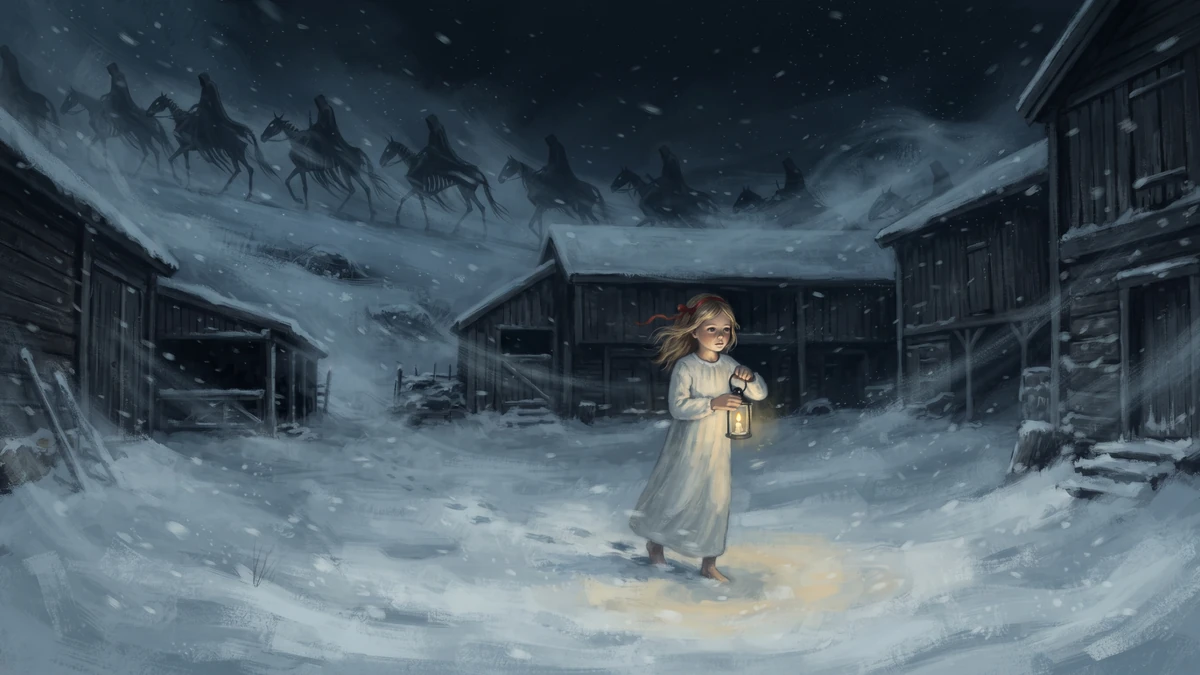
On 13 December, on farms in Norway and Sweden, the day ended early. According to folk tradition, it was Lussi’s night, the longest and darkest of the year, and anyone outdoors was in danger.
The longest night
In the old calendar, 13 December fell near the winter solstice. For that reason the date came to be seen as the longest night of the year, the Lussi Langnatt, “Lussi’s long night”, in Norwegian. In a country where the sun barely appears in winter, the idea that night was at its height made sense.
Lussi and her ride
Tradition says that on that night a female figure called Lussi went out with a band of creatures, the Lussiferda, Lussi’s ride. Whoever met the group could suffer harm. Accounts vary from region to region, and the figure is not the same everywhere, sometimes described as a witch, sometimes as a spirit.
The warnings were practical: finish work before dark, do not leave tools outdoors, do not spin or weave at night. In some regions people stayed awake and lit candles to keep danger away.
The light of Saint Lucy
The date coincides with the feast of Saint Lucy, a Christian martyr whose name means “light”. In Sweden the feast blended with winter customs: a young woman in a white dress and a crown of candles, followed by a procession, brings light into the darkness. The modern form of the procession became popular in the 20th century. Saffron buns, the lussekatter, are part of the tradition.
Scholars see here a mixture of folk customs with the Christian calendar, not a single ancient origin.
A custom that survives
Today Lussinatta is remembered mostly with candles and with the Saint Lucy procession, in schools and churches. The legend of Lussi lives on as a winter tale, told to explain why dark nights call for care.
Getting ready for Christmas
In many parts of Norway, Lussi night also marked the deadline for having everything ready for Christmas: the beer had to be brewed, the bread baked and the house cleaned. The word jól, the old midwinter festival, was older than the Christian Christmas, and some of these practices seem to have come from it. The Lussi legends, then, had a practical side: whoever believed in the danger of the dark night finished the season’s work in time.
To cross the yard without letting the flame go out, play Lussi’s flame.
Sources.
- 19th- and 20th-century collections of Norwegian and Swedish folklore on Christmas and winter customs
- Studies in Nordic ethnology on Lussi, Lussi night and Saint Lucy