Brokkr and Sindri forge Mjölnir: the wager in which Loki bet his own head
According to Snorri Sturluson, Thor's hammer was born from a wager between Loki and two dwarf smiths, and a fly spoiled the forging. Here is what the myth tells.
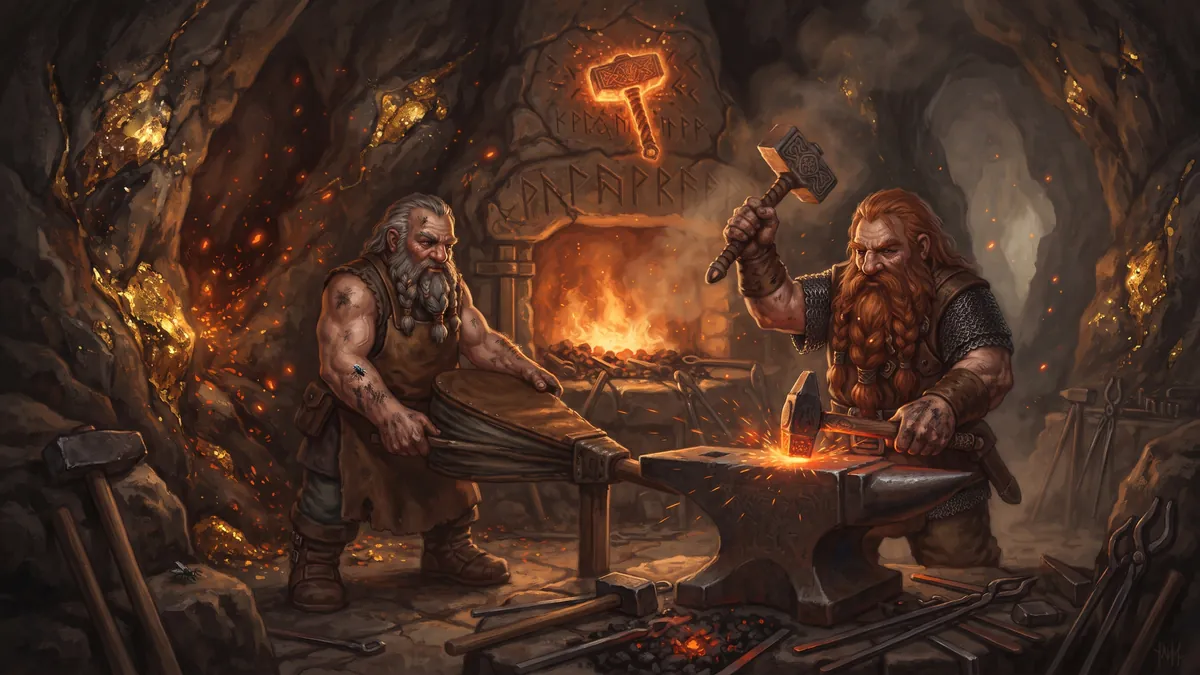
It began with a prank. According to the Skáldskaparmál, the second part of the Prose Edda, the god Loki cut off the golden hair of Sif, Thor’s wife. The thunder god seized Loki and promised to break every bone in his body. Loki swore he would find new hair, made of real gold, by the work of the dwarves.
The wager with the dwarves
Loki went to the sons of the dwarf Ívaldi, who forged the golden hair, the ship Skíðblaðnir and the spear Gungnir. But Loki did not stop there. He found a dwarf named Brokkr and bet his own head: Brokkr’s brother Sindri (whom some manuscripts call Eitri) could never make three treasures as good as those. The dwarves accepted.
Sindri put a pigskin in the forge and told his brother to work the bellows without stopping. A fly landed on Brokkr’s hand and bit him, but he did not stop. Out of the forge came a boar with golden bristles, Gullinbursti. In the second round, Sindri put gold in the fire, and the fly bit Brokkr’s neck; out came the ring Draupnir, from which eight more rings of equal weight drip every ninth night.
The third treasure
For the last one, Sindri laid iron in the embers. The fly, which was Loki in disguise, bit Brokkr on the eyelid. Blood ran into his eyes, and Brokkr let go of the bellows for a moment to wipe his face. Sindri drew a hammer from the forge, Mjölnir, and said it had only one flaw: the handle came out a little short.
The gods Odin, Thor and Freyr were the judges. According to Snorri, the hammer was chosen as the best treasure, because it would defend the gods against the frost giants. Thor kept it. Odin received the spear and the ring, and Freyr the boar and the ship.
The head and the neck
Seeing the wager lost, Loki tried to flee, but Thor brought him back. The trickster then argued that the deal was for his head, not his neck, and that Brokkr could not cut one without touching the other. Unable to cut him, Brokkr made holes in Loki’s lips with an awl and sewed his mouth shut with a leather strip. Loki tore out the stitches and got free.
From myth to pendants
The forging tale appears only in Snorri, written in the 13th century by a Christian Icelander, long after these beliefs had been lived. Snorri also says that Mjölnir never misses its mark, returns to Thor’s hand after being thrown and can be carried hidden under clothing. The poem Þrymskviða, for its part, shows the hammer as so valuable that the gods go in disguise to recover it.
Archaeology confirms that the hammer mattered. Many pendants in the shape of Thor’s hammer have been found in graves and settlements of the Viking Age. A mould found in Denmark was used to cast both hammers and crosses, which suggests people living between two beliefs. The sources do not say the pendant had power, and this text attributes power to none of them. What is known is that people wore them.
To try to swat the flies at the forge before they spoil the hammer, play Flies at the forge.
Sources.
- Snorri Sturluson, *Prose Edda* (*Skáldskaparmál*, around 1220)
- Unknown author, *Poetic Edda* (poems preserved in 13th-century manuscripts), especially the poem *Þrymskviða*
- Archaeological studies of Viking Age hammer-shaped pendants