The haunting of Fróðá: the door-court that tried the dead in Eyrbyggja saga
In the Eyrbyggja saga, the dead return to an Icelandic farm and leave only when a door-court summons them one by one. Here is what the saga tells, and what we know about it.
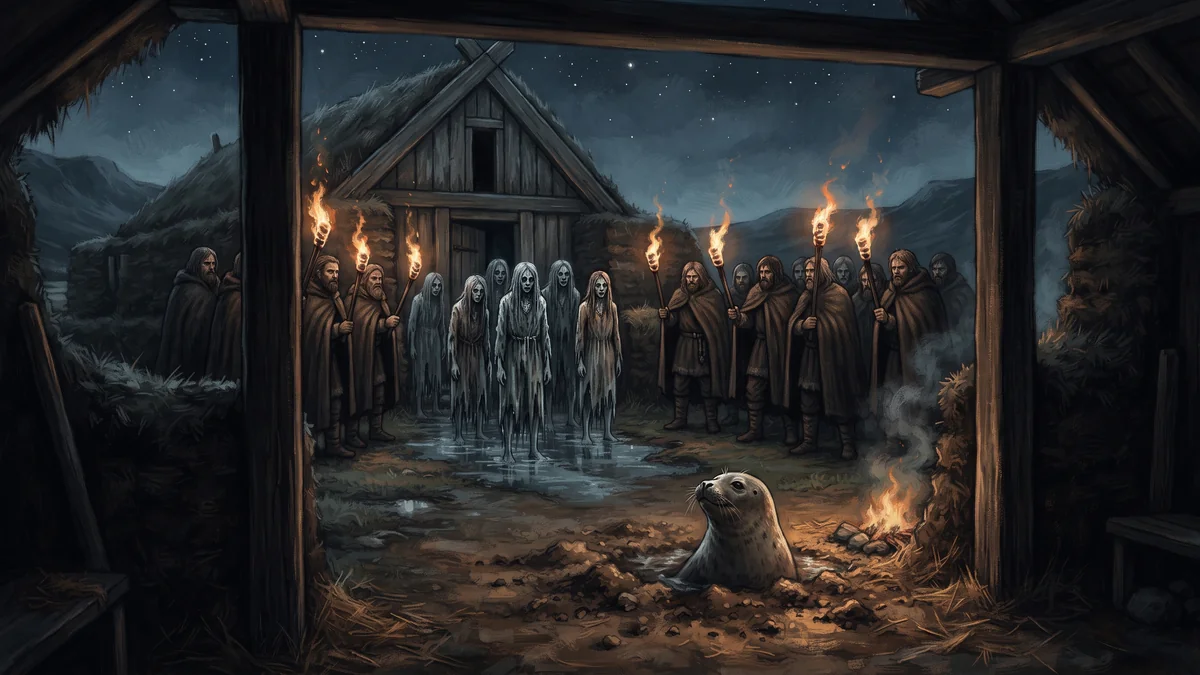
Among the sagas of the Icelanders, the Eyrbyggja saga keeps one of the strangest scenes: a farm where the dead return and the solution is a lawsuit. The saga was written around the 13th century and tells of episodes on the Snæfellsnes peninsula, in western Iceland.
The guest from the Hebrides
According to the saga, the story begins with the arrival of a woman called Þórgunna, from the Hebrides, at the farm of Fróðá. She brought very fine bedding and refused to share it. She fell ill and, before dying, asked for the bedding to be burned. The lady of the house, Þuríðr, wanted to keep it. Because of this, the accounts say, the trouble began.
Þórgunna’s body is said to have risen to prepare the household’s meal. There were other wonders too: the head of a seal came up out of the packed-earth floor of the hall, and sank only after being struck several times. All this, for the saga author, was explained by Þórgunna’s wish to be obeyed.
The drowned who returned
Then came a concrete tragedy. The master of the farm, Þóroddr, and his men drowned on a boat trip. On the night of the funeral feast, the dead entered the house, wet, sat by the fire and dried their clothes, and no one dared stop them. According to the saga, the custom was repeated for nights on end, and sickness began to strike the living. More people died, and returned.
The door-court
The solution has a legal name, dyradómr, the “door-court”. According to the saga, the household set up a court in front of the door of the house, as is done with a living defendant, and summoned the ghosts one by one. Each dead man was called by name and accused of invading the house. When the verdict was given, the ghost left the hall. The saga also describes the burning of Þórgunna’s bedding and, finally, Christian rites at the house, shortly after Iceland’s conversion, around the year 1000.
Specialists debate whether this court is the author’s invention or reflected a real practice. Icelandic laws, collected in the Grágás, deal with lawsuits with witnesses and summonses, and the scene seems to parody those rites. In any case, the text shows something that interested its audience: the law was a way of dealing even with fear.
No excavation has confirmed the events, and the saga was written about two centuries after the events it describes.
It is worth remembering that the Eyrbyggja saga is not only about ghosts. It is a chronicle of families and disputes in the Snæfellsnes region, and the chieftain Snorri goði is one of its central characters. The Fróðá episode is only one part of it, and the author seems more interested in showing how a community dealt with a problem than in frightening his audience.
To find out, as in the court, the right order of the accused waiting at the door, play The accused at the door.
Sources.
- Unknown author, *Eyrbyggja saga* (13th-century Icelandic saga), in *Íslenzk fornrit* IV (Hið íslenzka fornritafélag, 1935)
- Hermann Pálsson and Paul Edwards (trans.), *Eyrbyggja saga* (Penguin Classics, 1989)
- Unknown author, *Grágás* (laws of medieval Iceland, in 19th- and 20th-century editions)